
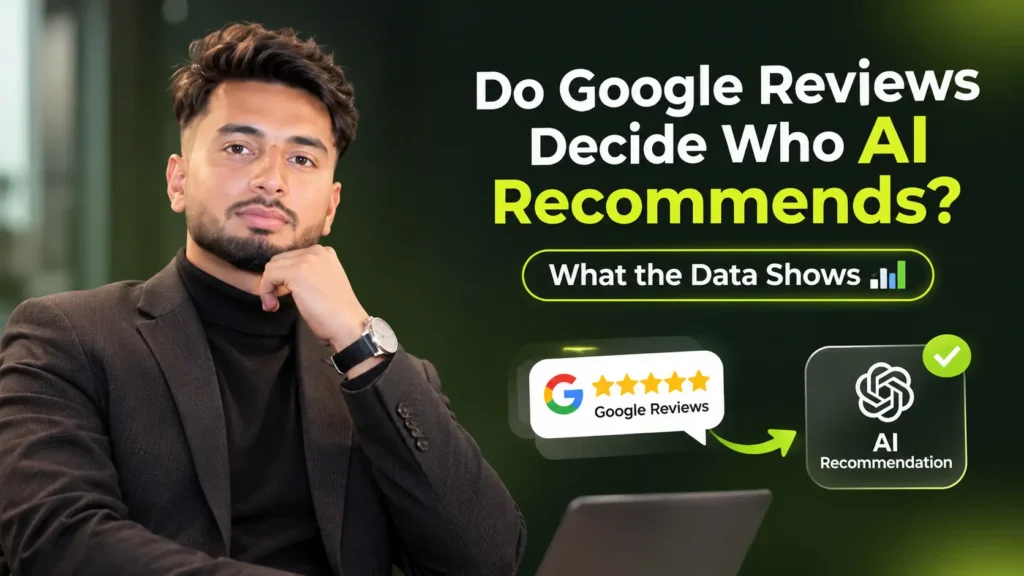
When someone asks ChatGPT to recommend a dentist, plumber, or marketing agency, some businesses appear in the answer while others are missing. This raises an important question: do Google reviews affect AI recommendations?
Reviews help customers understand a business’s reputation and service quality. AI platforms such as ChatGPT, Google AI Mode, and Perplexity can also use information from different online sources when answering business-related questions. Recent studies have found a connection between review volume and AI visibility. However, having more reviews does not guarantee that an AI platform will recommend your business.
In this guide, we will explore what the research says, which review signals may matter, and how to build a genuine review strategy.
Do Reviews Affect AI Recommendations?
The short answer is yes, reviews appear to be associated with AI recommendations, but they are not the only factor. Research published in 2026 found that businesses appearing in AI recommendations often had more Google reviews than businesses that were not mentioned.
This suggests that reviews may help AI systems and customers understand a business’s reputation. However, a relationship between two things does not prove that one directly causes the other. Businesses with more reviews may also have stronger websites, more customers, better-known brands, and more online mentions.
Different AI platforms also use different search systems and information sources. ChatGPT, Google AI Mode, and Perplexity may not recommend the same businesses. Therefore, reviews should be treated as one part of your online reputation, not a guaranteed way to get recommended.
What Does Research Say About Google Reviews and AI Search?
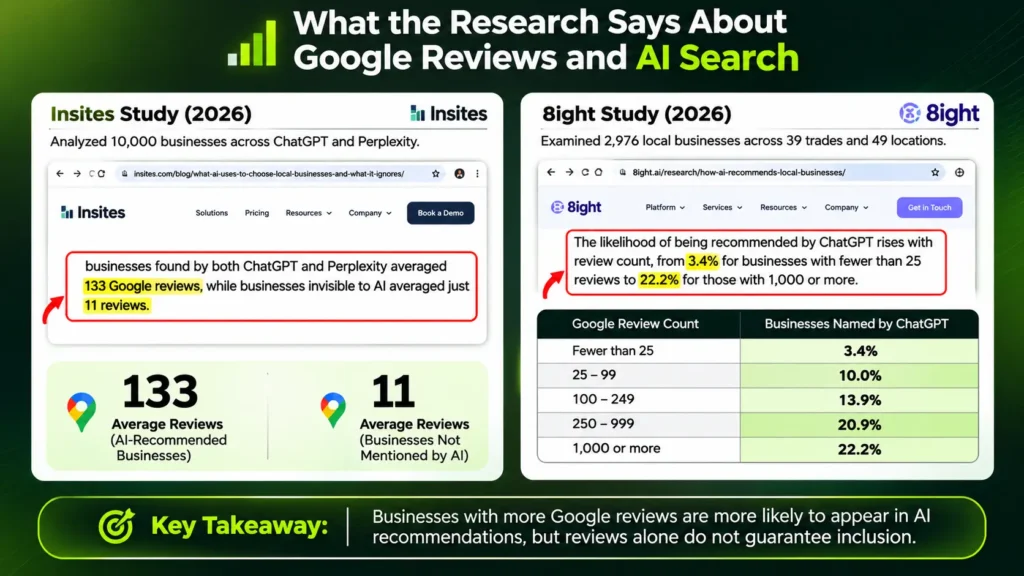
One useful source is the 2026 AI Visibility Report published by Insites. Its research analysed 10,000 businesses across ChatGPT and Perplexity and compared more than 200 digital marketing signals.
The Insites Study: 133 Reviews vs 11 Reviews
According to Insites’ research, businesses found by both ChatGPT and Perplexity averaged 133 Google reviews. Businesses that were invisible to AI averaged only 11 Google reviews.
| Research group | Average Google reviews |
|---|---|
| Businesses found by ChatGPT and Perplexity | 133 |
| Businesses invisible to AI | 11 |
This is a noticeable difference, but it does not mean that 133 reviews are required to appear in AI answers. The study also found that businesses appearing in Google’s Local Pack were recommended 3.5 times more often than businesses that did not appear there.
What Does the 8ight Study Show?
A separate study by 8ight examined 2,976 local businesses across 39 trades and 49 locations in the United States and Greater Toronto Area. It compared Google review counts with businesses mentioned in ChatGPT answers.
| Google review count | Businesses named by ChatGPT |
|---|---|
| Fewer than 25 | 3.4% |
| 25–99 | 10.0% |
| 100–249 | 13.9% |
| 250–999 | 20.9% |
| 1,000 or more | 22.2% |
Source: 8ight’s local AI recommendations study.
The results show that businesses with more reviews were more likely to be named in the study. However, even businesses with the highest review counts were often left out of ChatGPT recommendations. The study also found a median rating of 4.9 for both businesses named by ChatGPT and those not named. This suggests that a high star rating alone does not explain AI visibility.
What Should Businesses Learn?
Both studies suggest that review volume deserves attention. However, they are third-party studies, not official AI ranking rules. Their findings are based on selected businesses and locations, and they show relationships rather than proof that reviews cause recommendations. Results from the US and Canada may also not apply equally to Pakistan or other markets.
The practical lesson is to build genuine reviews while also improving your website and business information.
Which Review Signals May Matter to AI Systems?
Review information includes more than a star rating. Here are four areas worth monitoring.
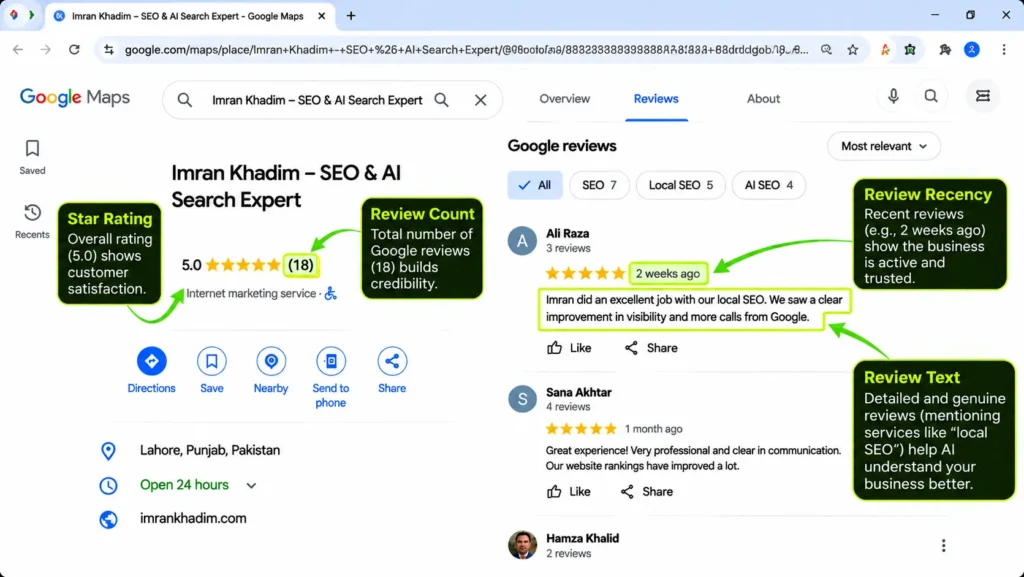
1. Review Count
Review count shows how many customers have shared their experiences. A larger number of genuine reviews gives customers more feedback to consider. Research from Insites and 8ight also found a relationship between review volume and AI recommendations. However, do not copy a competitor’s review count as your target. A new business should focus on earning genuine feedback at a natural pace.
2. Star Rating
Star ratings give customers a quick idea of other people’s experiences. Google’s official local ranking guidance explains that positive reviews and ratings can help local search prominence. However, this does not prove that a particular rating directly controls ChatGPT recommendations.
The 8ight study found a median rating of 4.9 for both businesses named and not named by ChatGPT. Focus on delivering good service instead of chasing a perfect rating.
3. Review Recency
Recent reviews help customers understand whether a business is still active and how it performs today. For example, a company with 150 old reviews may have less recent customer feedback than a competitor with 90 reviews collected over the last year.
Regular, genuine feedback helps customers make more informed decisions. However, the studies discussed here do not prove that a specific review age or posting frequency improves AI recommendations.
4. Review Text
The words customers use can explain what a business actually offers. For example, a customer might write: “We hired this company for an emergency boiler repair in Manchester. The engineer arrived on time and fixed the heating problem.”
This review mentions the service, location, and customer experience. Detailed feedback gives readers more context than a star rating alone. However, there is no confirmed rule that adding exact keywords to reviews improves AI visibility. Never ask customers to use scripted phrases. Let them describe their real experiences.
Do ChatGPT and Google AI Use the Same Review Sources?
No. Different AI platforms can use different information sources and search systems. ChatGPT Search can search the web and provide links to sources used in its answers. Other AI platforms may rely on different websites and information sources.
Business information can be available through business websites, Google Business Profiles, review platforms, industry directories, professional websites, and local publications. This is why businesses should not depend on Google reviews alone.
Keep your website and business details accurate across relevant platforms. Make sure your company name, services, phone number, and website information are consistent. You can also explore my Local SEO services to understand how reviews, business profiles, and local visibility fit into a wider strategy.
How to Build a Review Strategy That Supports AI Visibility
A good review strategy should focus on genuine customer experiences. Here are five practical steps.
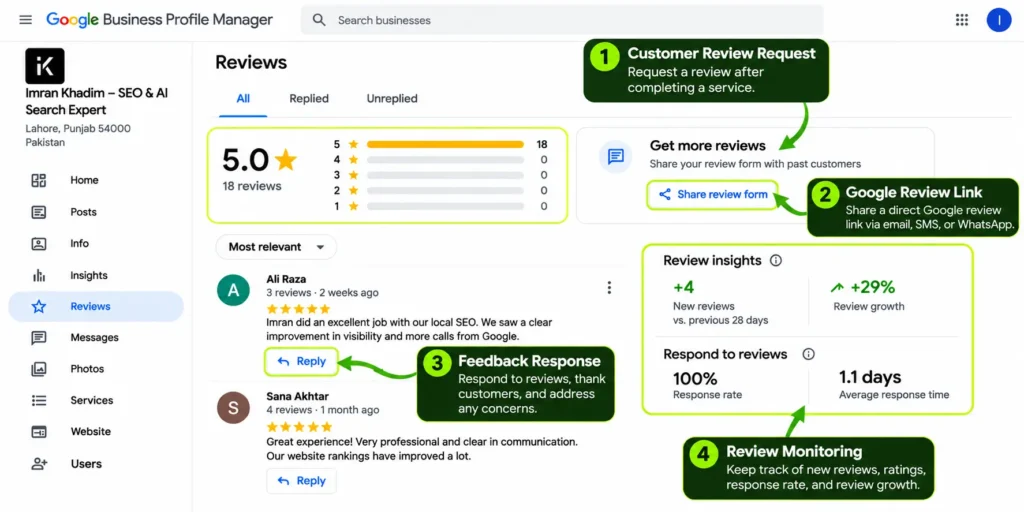
Step 1: Ask Customers After Completing a Service
Choose a natural point in the customer journey. For example, a dentist can ask after an appointment, while a plumber can ask after completing a repair. Send a polite message with a direct review link and make it clear that honest feedback is welcome.
Step 2: Make Leaving a Review Easy
Create a direct Google review link and share it through email, SMS, or a suitable follow-up message. A simple request is enough:
“Thank you for choosing our service. We would appreciate your honest feedback about your experience. You can share it through this review link.”
Do not offer rewards in exchange for positive ratings or ask only happy customers to leave reviews.
Step 3: Respond to Customer Feedback
Respond professionally to both positive and negative reviews. For positive feedback, thank the customer. For negative feedback, acknowledge the problem and explain how your business can help.
Avoid arguing publicly. If personal information is involved, move the conversation to a private channel.
Step 4: Monitor Relevant Review Platforms
Google may be important for local businesses, but other platforms can also matter depending on the industry.
| Platform | What to monitor |
|---|---|
| Review count, rating, recent feedback | |
| Industry directories | Business details and customer feedback |
| Professional platforms | Recommendations and service feedback |
| Social platforms | Public customer comments |
Focus on platforms your customers actually use instead of creating profiles everywhere.
Step 5: Learn From Repeated Feedback
Look for common comments about your business. Customers may repeatedly mention fast service, friendly staff, clear pricing, or poor communication.
Use this information to improve your service. Fixing a repeated problem is more valuable than simply trying to increase your review count.
A Practical Lahore Test: Do Reviews Affect ChatGPT Recommendations?
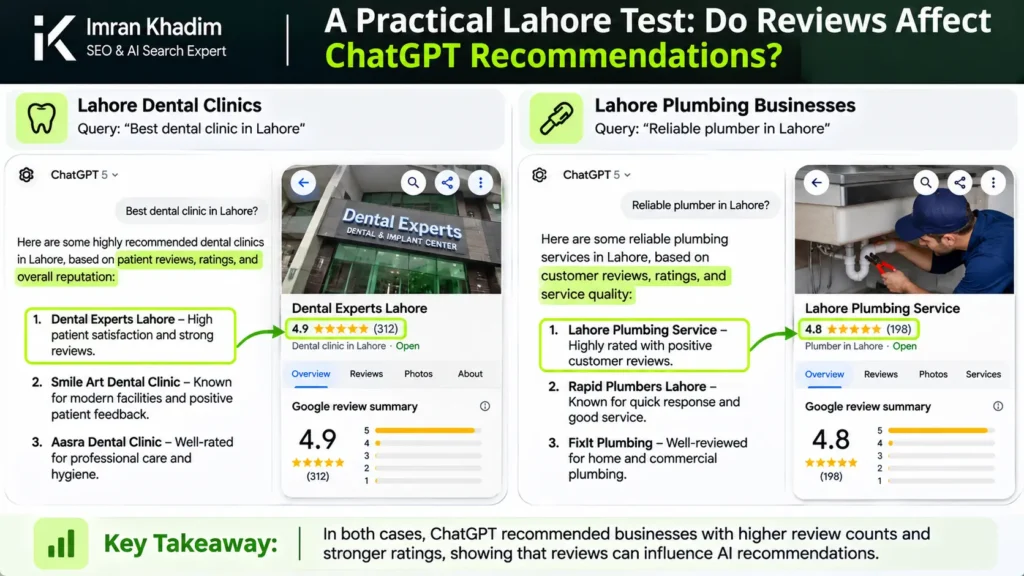
Research from the US and Canada does not represent every local market. A useful next step is to test two Lahore business niches: dental clinics and plumbing companies.
Use similar questions for each niche. For example:
Dental prompt: “Recommend reliable dental clinics in Lahore for general dental treatment. Name specific businesses and explain your choices.”
Plumbing prompt: “Recommend reliable plumbing companies in Lahore for home repair work. Name specific businesses and explain your choices.”
Follow this process: run each question in ChatGPT Search, record the businesses mentioned, find their matching Google Business Profiles, record review counts and ratings, save the AI answers and source links, and repeat with different wording and on different days.
| Business | Niche | Review count | Rating | Recommended? |
|---|---|---|---|---|
| Business A | Dental | Actual count | Actual rating | Yes/No |
| Business B | Dental | Actual count | Actual rating | Yes/No |
| Business C | Plumbing | Actual count | Actual rating | Yes/No |
| Business D | Plumbing | Actual count | Actual rating | Yes/No |
This is a research template, not completed Lahore research. Collect actual results before publishing any conclusions.
Common Review Mistakes to Avoid
| Mistake | Better approach |
|---|---|
| Buying Google reviews | Ask real customers for honest feedback |
| Offering rewards for five-star reviews | Keep review requests unbiased |
| Asking customers to use exact keywords | Let customers write naturally |
| Ignoring negative feedback | Respond professionally |
| Collecting reviews only once | Build a steady process |
| Focusing only on Google | Monitor relevant platforms |
Google prohibits fake reviews, paid reviews, and incentives in exchange for reviews. Read its official policy on fake and misleading reviews before creating a review campaign.
Frequently Asked Questions
1. Do Google reviews affect AI recommendations?
Research from 2026 found a relationship between review volume and AI recommendations. However, reviews do not guarantee that a business will be recommended.
2. How many reviews do I need for ChatGPT recommendations?
There is no fixed number. The Insites study found an average of 133 reviews for businesses discovered by both ChatGPT and Perplexity, but this is not a ranking requirement.
3. Does a five-star rating help AI recommendations?
A strong rating can help customers trust a business. However, the 8ight study found similar median ratings for businesses both named and not named by ChatGPT.
4. Does review recency matter?
Recent reviews help customers understand current service quality. However, there is no confirmed review-age requirement for AI recommendations.
5. Does ChatGPT read Google reviews?
ChatGPT Search can use different web sources. Research has found a relationship between Google review volume and recommendations, but OpenAI has not published a rule saying a specific Google review count determines recommendations.
6. Should businesses get reviews from multiple platforms?
Yes, when those platforms are relevant to their industry and customers. Different AI systems may use different information sources.
Final Thoughts
Google reviews are becoming an important part of the discussion around AI search visibility. Research from Insites and 8ight shows that businesses with more reviews were more likely to appear in certain AI recommendation samples.
But reviews alone do not decide who AI recommends. Businesses with hundreds of reviews can still be left out, while companies with fewer reviews can appear in answers.
Build a genuine review process, deliver good customer service, respond to feedback, and keep your business information accurate. Do not chase a review number just because a study found an average. Focus on building a reputation that customers can trust.