
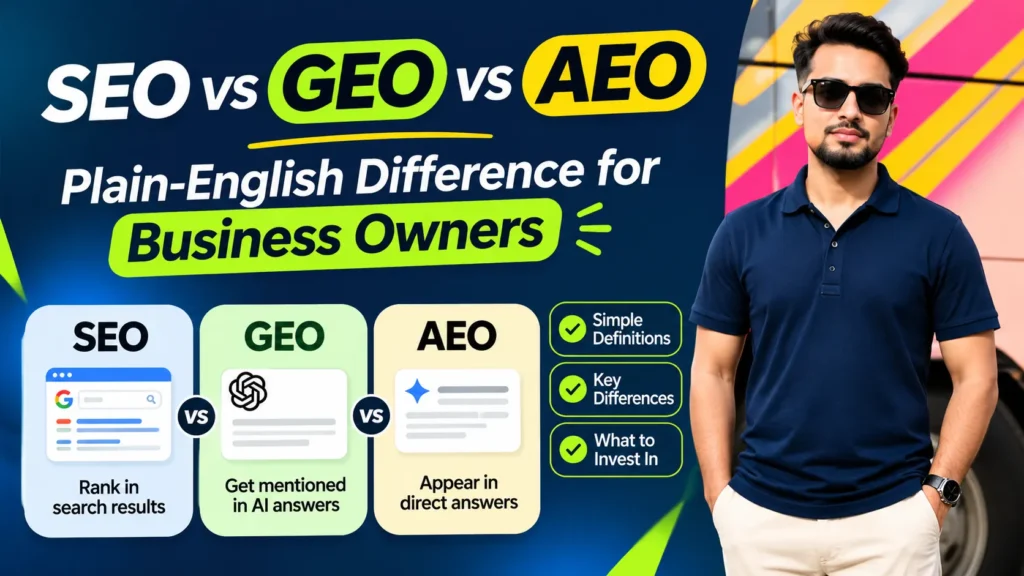
If you run a shop, clinic, restaurant, or service business, you have probably heard three terms: SEO, GEO, and AEO. Some marketers say you need SEO. Others say GEO or AEO is the future. This can make business owners feel that they need three different marketing strategies and three separate budgets.
The truth is much simpler. These terms describe different ways of improving your business’s visibility when people search online. SEO focuses on search engines, GEO focuses on generative AI answers, and AEO focuses on making information easy for answer-based systems to find and use. They overlap, and many of the same good website practices support all three.
SEO vs GEO vs AEO: What Is the Difference?
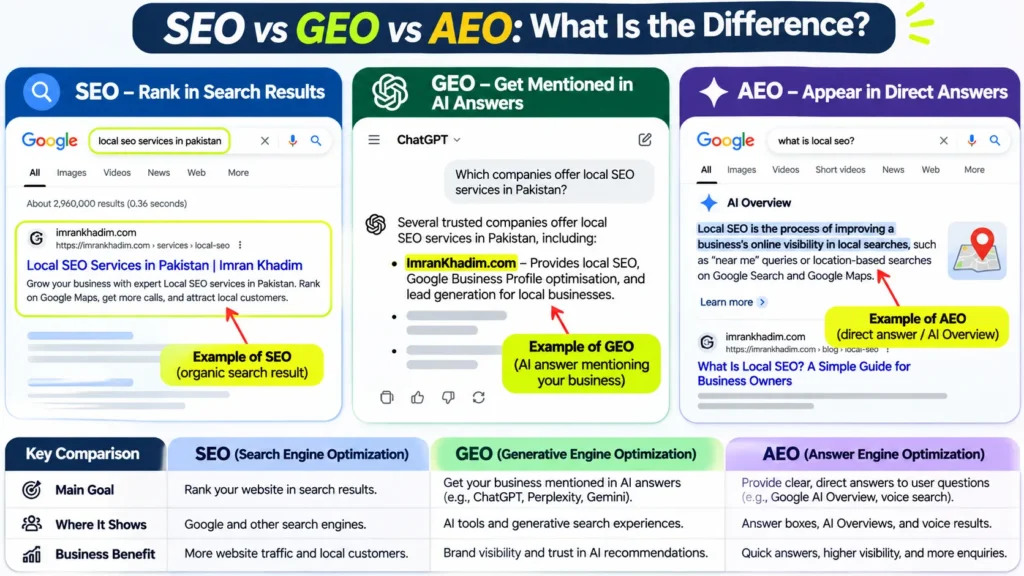
Here is the simplest way to understand them. SEO helps people find your website in search results. GEO helps your business or content become visible in answers created by generative AI tools. AEO helps your information appear as a clear answer when someone asks a question through a search engine, voice assistant, or answer platform.
| Term | Full form | Main goal | Example |
|---|---|---|---|
| SEO | Search Engine Optimization | Improve visibility in search results | Your plumbing service appears on Google |
| GEO | Generative Engine Optimization | Improve visibility in AI-generated answers | ChatGPT mentions your plumbing business |
| AEO | Answer Engine Optimization | Make your information easy to use in direct answers | Google shows a clear answer from your FAQ |
These are useful working definitions, not three official Google ranking systems. The terms are used differently across the marketing industry, especially AEO. Google itself describes GEO and AEO as terms used for work focused on visibility in AI search experiences, while explaining that its core SEO practices remain relevant.
1. What Is SEO?
SEO stands for Search Engine Optimization. It is the process of improving your website so search engines can find, understand, and show your pages when people search for related products or services. For a local business, this could mean appearing when someone searches for a dentist in London, a restaurant in Lahore, or an electrician near them.
SEO includes several connected areas. Technical SEO helps search engines access your website, on-page SEO makes your pages clear and useful, and local SEO helps your business appear for searches connected to a location. Your website also needs helpful content, clear service information, and a good experience on mobile devices.
Example: Imagine you own a dental clinic in Manchester. Someone searches for “dental clinic in Manchester”. Your service page, location information, and business profile can help your clinic appear in relevant search results. This is a practical example of SEO supporting a real customer search.
SEO is still the foundation of online visibility. Google says the same basic SEO practices remain useful for its AI features, including AI Overviews and AI Mode. You can learn more about the work involved through my local SEO services.
2. What Is GEO?
GEO stands for Generative Engine Optimization. It focuses on improving the chances that your business or website content will be found, referenced, or cited in answers produced by generative AI systems. These systems can include ChatGPT, Perplexity, Gemini, and Google’s AI search features.
Traditional search results often show a list of website links. Generative AI tools may combine information from several sources and produce one answer. They may also include links to some of the sources they used. GEO is about making your information useful, clear, reliable, and accessible so it has a better chance of being considered in these experiences.
Example: A customer asks an AI tool, “Which dental clinics in Manchester offer teeth whitening?” The tool may mention several clinics and provide links to their websites. If your clinic is included, your business has gained visibility through a generative AI answer.
GEO is a developing field, and there is no guaranteed formula for getting mentioned by every AI platform. The original academic research on GEO introduced the term and studied methods for improving content visibility in generative engine responses. Its findings should not be treated as a promise that a specific technique will increase every business’s visibility by a fixed amount.
3. What Is AEO?
AEO stands for Answer Engine Optimization. It means making your website information clear and useful for systems that provide direct answers to questions. Instead of only trying to appear as a website link, the goal is to make it easier for a search or answer system to understand the answer your page provides.
For example, a customer may search “What time does your shop close?” or ask a voice assistant, “Where can I find a car repair shop in Birmingham?” Clear opening hours, service details, location information, and well-organised answers can help customers find the information they need.
AEO is not limited to AI chatbots. The term has also been used for featured snippets, voice search, and other answer-focused search experiences. Because marketers use the term in different ways, always ask a provider what work they include when they sell an AEO service.
One Simple Diagram: How SEO, GEO, and AEO Work Together
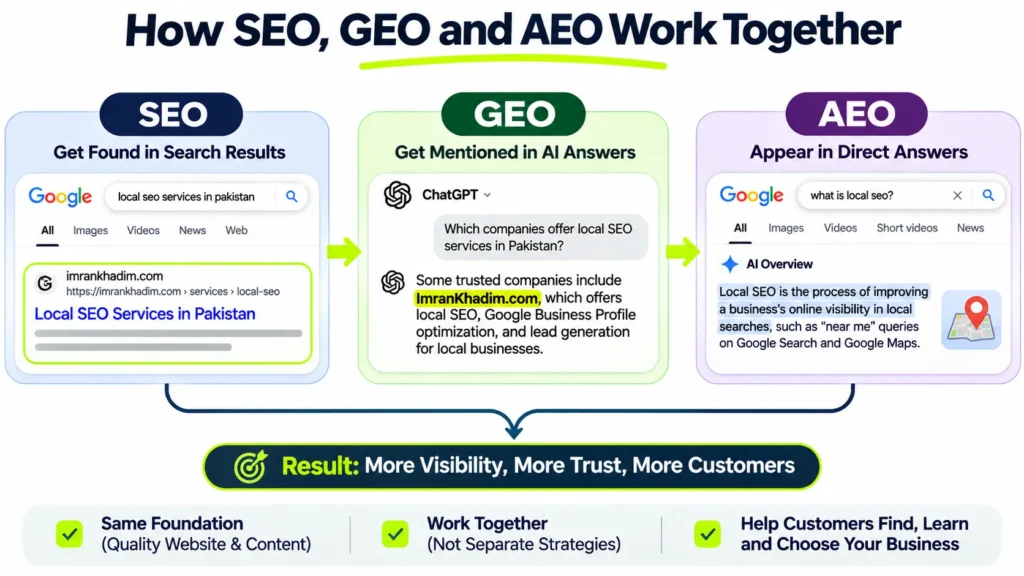
Think of these three areas as connected parts of one online visibility plan, not three separate marketing departments.
SEO → GEO → AEO
- SEO: Help search engines discover and understand your website.
- GEO: Make your useful information accessible and valuable for generative AI answers.
- AEO: Present clear answers that search and answer systems can understand.
This diagram is a simple way to remember the terms, not a technical process that every platform follows in the same order. In real life, one well-built service page can support all three at the same time.
SEO vs GEO vs AEO: A Practical Business Comparison
The differences become easier to understand when you look at what a customer does and what your business needs to provide.
| Business need | SEO | GEO | AEO |
|---|---|---|---|
| Appear in Google search results | Main focus | Can support AI search visibility | Can support direct answers |
| Be mentioned in AI-generated answers | Not its only goal | Main focus | May overlap |
| Answer customer questions clearly | Important | Important | Main focus |
| Improve local service visibility | Local SEO | AI business discovery | Clear local business answers |
| Get website visits | Often a key goal | May bring cited visits | Depends on the answer experience |
The biggest point is that you do not need to choose only one. A useful website can appear in traditional search results, provide information for AI answers, and answer customer questions clearly. These goals support each other.
What Should a Small Business Pay For?
If you own a local business, do not buy three separate services just because a marketer uses three different names. First, check whether your website has the basic work in place. If Google cannot access your important pages, your service information is unclear, or your business details are incomplete, buying a separate GEO or AEO package will not fix those problems.
| Your current situation | What to prioritise |
|---|---|
| Your website does not appear for important services | SEO and technical checks |
| Your business is missing from local searches | Local SEO and business profile improvements |
| Your pages do not answer customer questions | Content improvements and AEO-style formatting |
| Your website is useful but rarely appears in AI answers | Review AI visibility and GEO opportunities |
| You cannot measure what is working | Search Console, analytics, and lead tracking |
For most small businesses, start with SEO foundations and local visibility. Make sure your important service pages explain what you offer, where you work, and how customers can contact you. Then improve your content so it answers real customer questions. Once these basics are in place, you can review AI visibility as an additional opportunity.
If you want to understand the wider connection between traditional search and AI discovery, read my AI search and GEO strategy guide.
What Is Hype and What Actually Matters?
The growing interest in GEO and AEO has created many marketing claims. Some providers promise guaranteed ChatGPT mentions, instant AI rankings, or special website changes that supposedly make every AI platform recommend a business. Be careful with these promises. No provider can control every answer generated by an independent AI system.
Google’s guidance says there are no special schema types or extra technical requirements that guarantee inclusion in AI Overviews or AI Mode. It recommends following established SEO practices, making content helpful and reliable, allowing crawling, and keeping structured data consistent with visible page content.
This does not mean GEO and AEO are useless. They can be helpful ways to think about new search experiences and how customers discover businesses. But they should lead to practical improvements, not unnecessary tools, fake mentions, or expensive promises.
A Simple Action Plan for Business Owners
You can begin without changing your whole marketing budget. First, check whether your website has a clear page for every important service. Make sure each page explains what the service includes, who it helps, which areas you cover, and how customers can contact you.
Next, review your business information across your website and business profiles. Check your address, phone number, opening hours, service details, and customer reviews. Make sure the information is accurate and easy to understand. You can use my AI and voice SEO service page to explore how AI-focused visibility fits into a wider SEO plan.
Finally, measure results. Use Google Search Console to check search clicks and impressions, analytics to understand website visits, and your call or enquiry records to measure business results. You can also test a small set of real customer questions in AI platforms and record whether your business is mentioned or cited. Do not judge your entire strategy from one AI answer because results can change.
Frequently Asked Questions
Is GEO better than SEO?
No. GEO and SEO have different but connected goals. SEO supports visibility in search engines, while GEO focuses on visibility in generative AI answers. A strong SEO foundation can also support your presence in AI search experiences.
What is generative engine optimization?
Generative Engine Optimization is the practice of improving the visibility of website content in answers created by generative AI systems. It focuses on making information useful, clear, accessible, and suitable for AI-powered discovery.
What is the difference between AEO and SEO?
SEO aims to improve visibility in search results, while AEO focuses on making information easy for answer systems to understand and use in direct responses. Both can support the same website and content.
Does a small business need SEO, GEO, and AEO?
A small business does not need three separate budgets. Start with useful website content, technical SEO, accurate local business information, and clear answers to customer questions. These foundations can support all three areas.
Can GEO guarantee that ChatGPT recommends my business?
No. AI platforms choose their answers and sources using systems that businesses cannot fully control. You can improve your website and online information, but no honest provider can guarantee that an AI platform will recommend your business.
Final Thoughts
SEO, GEO, and AEO are not three competing versions of digital marketing. They describe connected ways people may discover your business through search results, AI-generated answers, and direct responses. SEO remains the foundation, while GEO and AEO help businesses think about newer ways customers find information.
If you run a small business, keep your plan simple. Build a useful website, explain your services clearly, maintain accurate local information, and answer real customer questions. Measure calls, enquiries, and sales instead of chasing every new marketing term. Invest in work that helps customers find and trust your business.