
People keep asking the same question: is SEO dead in 2026? With Google AI Overviews, ChatGPT, and other AI tools changing how people search, it is easy to think that traditional SEO no longer works. Some websites are losing clicks, especially from informational searches where users can get quick answers without visiting another page.
But SEO is not dead. The way people search and choose businesses is changing. Local customers still need to find nearby services, compare providers, check reviews, and contact businesses. The real challenge is to stop measuring success only through website traffic and focus more on qualified leads, calls, bookings, and sales.
Is SEO Dead in 2026? The Short Answer
No. SEO is not dead in 2026, but relying only on old SEO methods is becoming less effective. Publishing large numbers of basic articles and trying to rank for every possible keyword is not a strong plan on its own. Search engines now provide more direct answers, and customers use several platforms before making a decision.
This does not mean businesses should stop investing in SEO. It means they should focus on searches that bring the right people to their websites and business profiles. A local customer looking for a dentist, plumber, lawyer, or car rental company still needs accurate business information and a way to contact the provider.
What Has Actually Changed in Search?
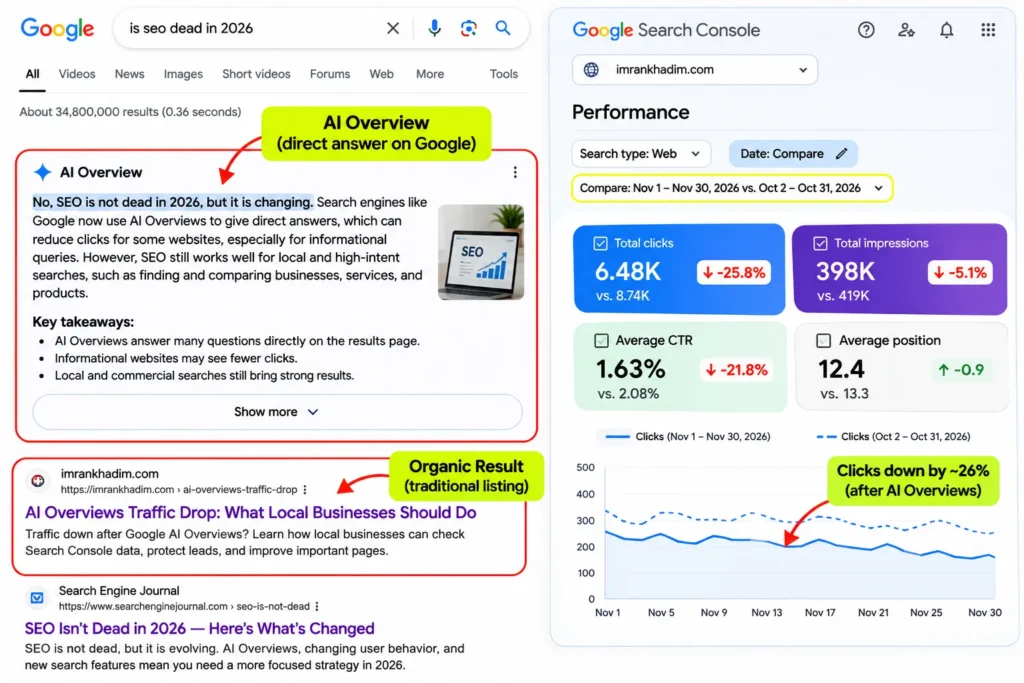
The biggest change is that users can find information without always clicking a website. Google AI Overviews may answer questions directly on the search results page. AI assistants can also compare services and provide recommendations. As a result, some websites receive fewer clicks even when they continue to appear in search results.
A 2026 study by Seer Interactive analysed 5.47 million queries across 53 brands and 2.43 billion organic impressions. It found that organic click-through rates were affected by AI Overviews, especially when a brand was not cited in the AI answer. The study also found that results varied by search intent and that some click-through rates began to stabilise in early 2026. These figures come from the study’s tracked brands and queries, not every website on the internet. <Cite refs={[“turn631492search0”]}/>
The important lesson is that impressions, rankings, and clicks do not always move together. A page may continue to appear in Google but receive fewer clicks. That is why businesses should look beyond total organic traffic when judging whether their SEO is working.
Real Numbers: Are People Still Using Google for Local Searches?
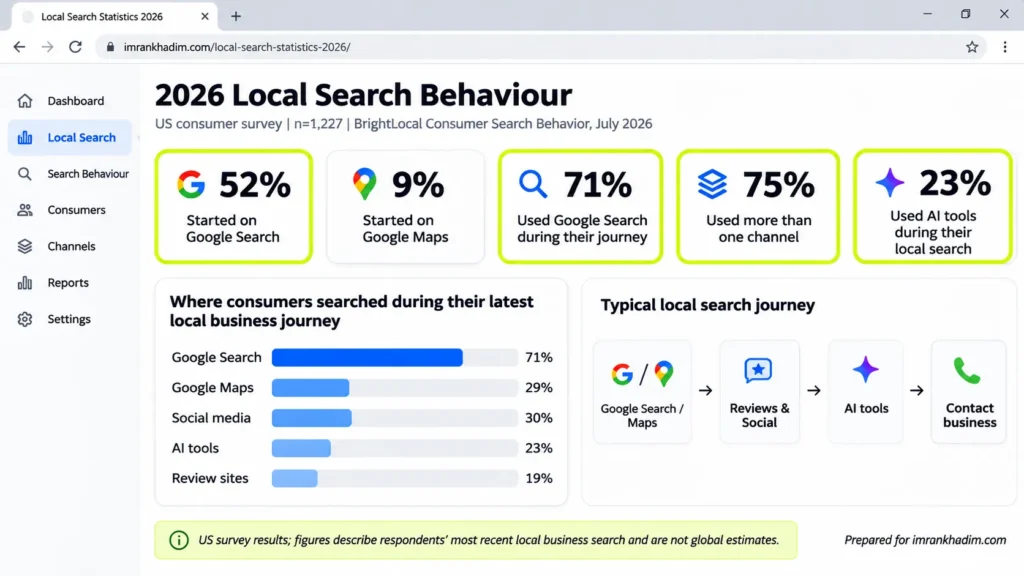
Yes. Local search is still an important part of how consumers find businesses. BrightLocal’s 2026 Consumer Search Behavior research surveyed 1,227 US consumers who had searched online for a local business in the previous three months. Its findings show that Google remains a major starting point, while other channels also play a role.
| Finding from BrightLocal’s 2026 research | Result |
|---|---|
| Consumers who started their latest local business search on Google Search | 52% |
| Consumers who started on Google Maps | 9% |
| Consumers who used Google Search at some point in their search journey | 71% |
| Consumers who used more than one channel | 75% |
| Consumers who used AI tools during their local search journey | 23% |
These numbers show that customers are not choosing between Google and AI as if they can use only one. They may discover a business on Google, check its reviews, look at its social media, and use an AI tool before making a decision. The research is US-based, so do not treat these percentages as exact figures for the UK, Pakistan, or every other market.
<Cite refs={["turn631492search3"]}/>For local businesses, this is a strong reason to maintain a useful website, an accurate Google Business Profile, and consistent business information across trusted platforms. Your customers may use more than one source before contacting you.
Why Local SEO Still Matters
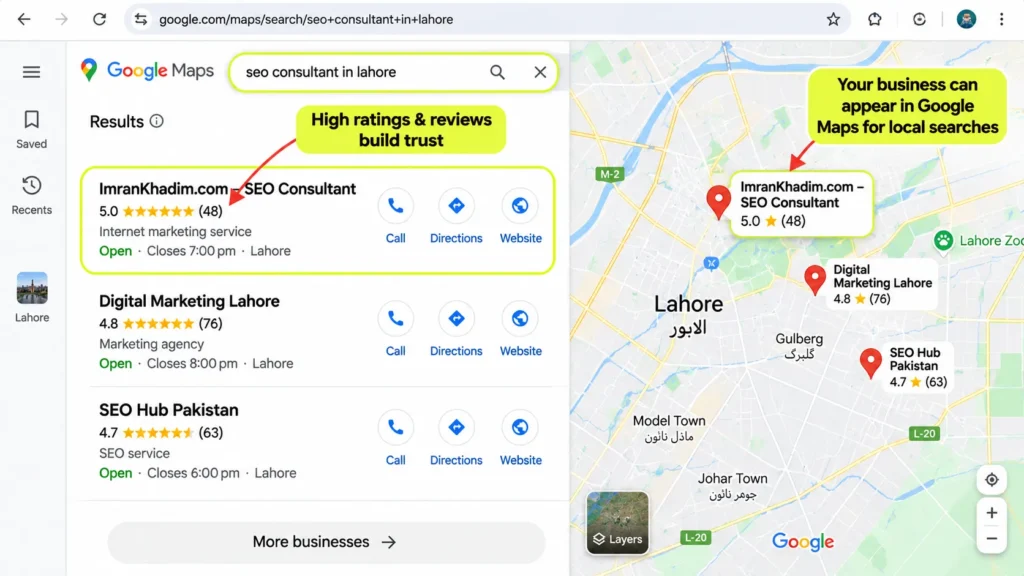
Local SEO helps businesses appear when people search for services in a specific area. These searches often show clear intent. Someone searching for “emergency electrician in Manchester” is likely looking for a provider, not a general explanation of how electricity works.
Google explains that local results are mainly based on relevance, distance, and prominence. Relevance means how well a business matches the search. Distance refers to how far the business is from the searcher, while prominence relates to how well-known the business is. Google also says that complete business information, links, and reviews can help its systems understand and assess a business. <Cite refs={[“turn631492search2”]}/>
This is why a local business should not abandon SEO because AI tools are growing. A complete business profile, useful service pages, clear contact details, and genuine customer reviews still help people make decisions. You can use my local SEO service to understand the main areas that need attention.
Informational Traffic and Local Customer Intent Are Different
Not every website visitor has the same value. Someone reading a basic article may only want a quick answer, while someone searching for a nearby service may be ready to call or book. AI answers can affect these two types of searches differently.
| Search type | Example query | Main user goal | Business value |
|---|---|---|---|
| Informational | What is a dental crown? | Learn something | May support awareness |
| Commercial | Best dental clinic for implants | Compare providers | Stronger buying interest |
| Local service | Dentist near me | Find a nearby provider | Potential appointment |
| Transactional | Book a dentist appointment today | Take action | High conversion intent |
This does not mean informational content has no value. Helpful articles can build trust and introduce people to your services. However, a business should not depend on basic informational traffic alone. Service pages, location pages, pricing details, case studies, and clear contact options should support the customer journey.
If your website has lost clicks after AI Overviews appeared, check whether the decline is limited to blog posts or also affects important service pages. My guide on AI Overviews traffic drops explains how to separate informational traffic loss from changes in leads and enquiries.
What Should Local Businesses Do in 2026?
The answer is not to publish more content or chase every new AI platform. Build a website and online presence that helps customers find, trust, and contact your business. Start with the pages and information that support real buying decisions.
1. Improve Your Service Pages
Each important service should have a useful page that explains what you offer, who the service is for, where you provide it, and how customers can contact you. Avoid pages that repeat the same general information with only a city name changed. Add real details about your process, experience, service limits, and common customer questions.
2. Keep Your Google Business Profile Accurate
Check your business name, address, phone number, opening hours, service areas, and categories. Add genuine photos and keep your services updated. Ask real customers for honest reviews and respond professionally. Do not buy reviews or create fake business locations.
3. Make Your Website Easy to Use on Mobile
Many local searches happen on mobile phones. Customers should be able to read your service information, tap your phone number, find directions, and submit an enquiry without difficulty. Test your website on a real phone and fix pages that are slow, confusing, or difficult to navigate.
4. Build Trust With Real Business Information
Show your experience, team details, work examples, service areas, and clear contact information. Add genuine case studies when you have permission to share them. Make sure your business details are consistent across your website and important listings. These details help customers understand who they are dealing with.
5. Track Leads, Not Just Rankings
Rankings and traffic can help you understand search performance, but they do not show the full business result. Track phone calls, contact forms, bookings, qualified enquiries, and sales from organic search. Compare these numbers with clicks and impressions so you can see whether SEO is bringing useful customers.
How to Know If SEO Is Still Working for Your Business
Use Google Search Console to review clicks, impressions, CTR, and average position. Compare the same date ranges and separate service pages, location pages, and blog posts. Then check your analytics and lead records to understand which pages help generate enquiries.
For example, imagine a business receives 1,000 organic visits in one month and 20 qualified enquiries. The next month, visits fall to 800 but enquiries remain at 20. Traffic has dropped by 20%, but the number of enquiries has not changed. This is an illustrative example, not a real client result. It shows why traffic alone should not decide whether your SEO investment is working.
For a better review, use a simple monthly report:
| Metric | What it tells you |
|---|---|
| Organic clicks | How many visits came from Google search results |
| Impressions | How often your pages appeared |
| CTR | How often people clicked after seeing your result |
| Service-page traffic | Whether important commercial pages attract visitors |
| Phone calls and forms | Whether visitors contact your business |
| Qualified leads | Whether enquiries match your services |
| Sales or bookings | Whether SEO contributes to business results |
You can also review your local SEO checklist to find gaps in your website and business profile. The aim is to understand what brings customers, not simply to increase every number in a report.
Common SEO Mistakes to Avoid in 2026
Do not stop SEO because one blog post has lost traffic. First, find out which queries and page types have changed. Avoid publishing generic articles that offer no new information, creating multiple weak location pages, or buying fake reviews and links. Do not ignore your Google Business Profile or let important service information become outdated.
Another mistake is treating AI search as a complete replacement for Google. Customers may use search engines, Maps, review websites, social media, and AI tools during the same buying journey. Your business should provide clear and consistent information wherever customers may look.
Frequently Asked Questions
Is SEO dead now with AI?
No. AI is changing how people discover information, but search engines remain important for finding businesses, comparing services, and taking action. Businesses need to adapt their strategy rather than abandon SEO.
Is local SEO still worth it in 2026?
Yes. Consumers continue to use Google Search and Maps when looking for local businesses. A well-maintained website and business profile can help customers find accurate information and contact nearby providers.
Will AI Overviews replace traditional Google search?
AI Overviews change how some search results appear, but they do not remove the need for websites and business information. Many searches still require users to compare providers, check details, and take action.
Should small businesses invest in SEO or AI search?
Start with a strong SEO foundation: useful service pages, accurate business information, mobile usability, and genuine customer reviews. Then improve how your business is understood and represented across relevant AI platforms. Do not ignore the channels your customers already use.
How long does local SEO take to show results?
There is no fixed timeline. Results depend on competition, location, website condition, business history, and the work required. Track progress over time instead of expecting every business to see the same result.
Final Thoughts
SEO is not dead in 2026. What is changing is how people discover information and how they decide which business to trust. Informational websites may lose some clicks as AI answers become more common, but local customers still need reliable providers, clear service information, reviews, and ways to get in touch.
For local businesses, the smart move is to focus on useful pages, accurate business profiles, customer trust, and qualified leads. Measure calls, enquiries, bookings, and sales alongside traffic. Do not chase clicks that never become customers. Build an online presence that helps the right people find your business and choose your services.