

Local SEO is won in this order: a complete Google Business Profile, a steady flow of genuine reviews, one strong page per service and location, the same name, address and phone (NAP) everywhere, valid LocalBusiness schema, and content clear enough for Google’s AI answers to quote. This checklist covers all of it, in the order I do the work for clients.
Most local businesses do not lose on Google Maps to a secret trick. They lose because small things were never finished: the wrong primary category, services missing from the profile, three phone numbers across directories, or one location page copied five times with only the city changed.
Google says local results depend on three things: relevance, distance and prominence. You cannot change distance. Everything on this checklist improves the other two.
What this checklist is based on
I run local SEO for clinics, rent a car companies and service businesses in Pakistan and the United States. On the New York clinic profiles I manage, calls reached 2,506 (+1,082%), profile actions reached 4,918 (+587%) and direction requests reached 1,005 (+172%).
None of that came from a hidden tactic. It came from finishing the boring items below, checking them every month, and fixing what slipped. Each section shows what to check, how to check it, and the mistake I find most often in audits.
What changed in local SEO
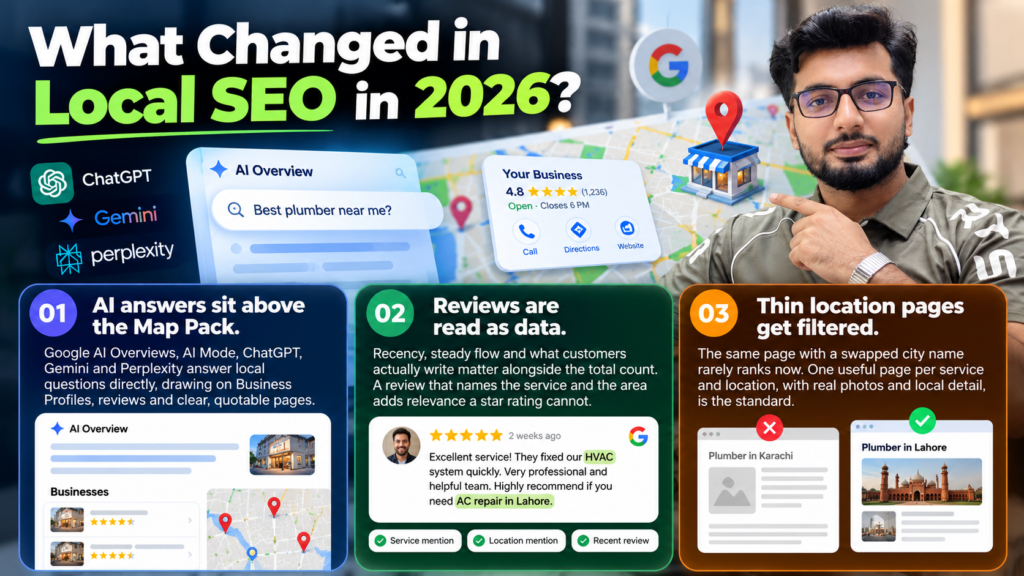
- AI answers sit above the Map Pack. Google AI Overviews, AI Mode, ChatGPT, Gemini and Perplexity now answer local questions directly. They pull from Business Profiles, reviews and clear pages. That is why sections 15 and 16 cover AEO and GEO. My AI search strategy guide explains the wider picture.
- Reviews are read as data. How recent they are, how often they come in, and what customers write all matter, not just the total. A review that names the service and the area helps relevance in a way a star rating cannot.
- Google tightened review rules. Google’s Maps content policy bans review quotas for staff and asking customers to mention specific words. Ask for honest reviews only.
- The Q&A section is gone. Google removed Business Profile Q&A in November 2025 and now uses AI answers built from your profile and reviews. Your profile details and website must answer common questions instead.
- Thin location pages get filtered. The same page with a swapped city name rarely ranks now. One useful page per service and location, with real photos and local detail, is the standard.
The 10 minute local SEO health check
Before the full checklist, answer these ten questions. Every “no” is a gap worth fixing first.
| # | Question | Where to check |
|---|---|---|
| 1 | Is your primary category the most specific one that fits? | Your Business Profile |
| 2 | Are all your services listed in the profile? | Business Profile, Services |
| 3 | Did you get at least one new review in the last 30 days? | Google Maps listing |
| 4 | Have you replied to every review? | Google Maps listing |
| 5 | Is your NAP exactly the same on your website and profile? | Website footer and contact page |
| 6 | Does each service have its own page? | Your website menu |
| 7 | Are your location pages indexed? | Search Console, URL Inspection |
| 8 | Does your LocalBusiness schema pass with no errors? | Rich Results Test |
| 9 | Does the profile website link carry UTM tags? | Business Profile, Website field |
| 10 | Can a mobile visitor tap “call” without scrolling? | Your phone |
How to use this checklist
Work in order. Sections 1 to 3 set strategy, 4 to 10 build the foundation, 11 to 14 build authority, 15 to 18 cover AI search and measurement, and 19 to 20 turn rankings into revenue.
Short on time? Do these five first:
- Fix your Google Business Profile: primary category, services, hours, photos.
- Start a review request after every job.
- Make your name, address and phone identical everywhere.
- Build one proper page per service, with the city in the title, H1 and first paragraph.
- Add and validate LocalBusiness schema.
Download this checklist as a printable PDF
The full checklist is also available as a free printable PDF with tick boxes and a scorecard.
Download the Local SEO Checklist (PDF, 8 pages)
If you use Google Search Console, you may also like my free Chrome extension, Search Console Regex, which applies regex filters in one click.
01: Local SEO strategy
- Local Search Intent
- Local Keyword Research
- SERP Analysis
- Competitor Analysis
- Keyword-to-Page Mapping
- Service-Area Targeting
- Location-Based Search Demand
- Conversion-Focused SEO
What good looks like: every service has exactly one page mapped to it, and you know from the live search results who holds the Map Pack today. Strategy also means deciding what not to chase, such as keywords in cities you do not serve.
How to check it:
- List every service you sell in one column of a sheet.
- Next to each one, write the one URL that targets it. Blank cells are missing pages.
- Search each service plus your city on your phone, in a private window. Note the three businesses in the Map Pack.
- Mark which services earn you the most money. Those get worked on first.
Mistake I see most: chasing the biggest keyword in the city when the business makes more profit from a smaller service with less competition.
02: Google Business Profile
- GBP Optimization
- Primary & Secondary Categories
- Business Information Accuracy
- Services & Products
- Business Description
- Opening Hours
- Photos & Videos
- Google Posts
- Business Attributes
- Appointment Links
- UTM Tracking
- Duplicate Listing Management
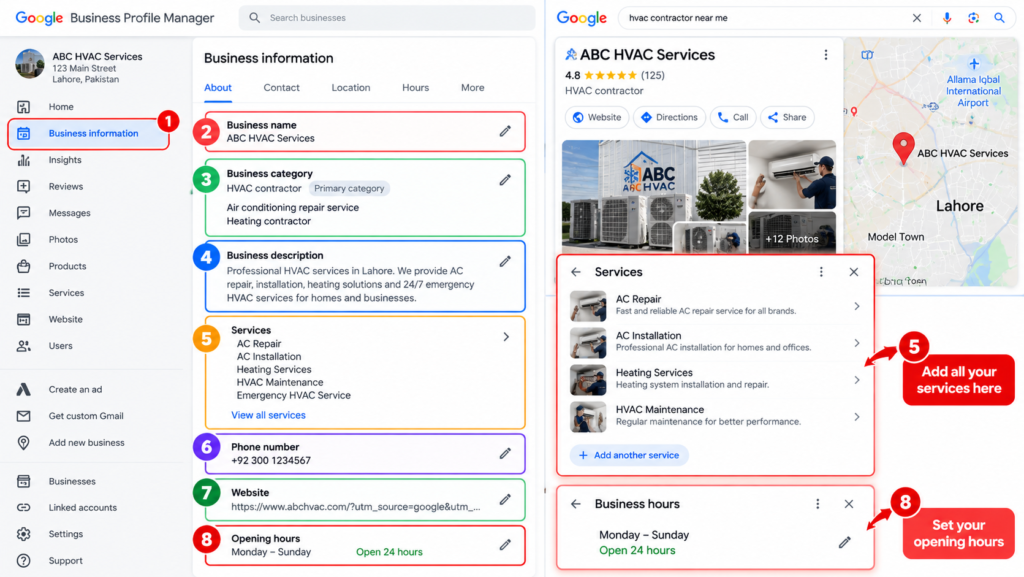
What good looks like: the primary category is the most specific true one, such as “HVAC contractor” rather than “Contractor”, because it is the strongest relevance signal you control. Every service is listed one by one. The website link carries UTM tags (utm_source=google&utm_medium=organic&utm_campaign=gbp) so GA4 can measure profile traffic.
| Field | Rule that matters |
|---|---|
| Business name | Your real name only, as on your signboard. No keywords or city names added. |
| Primary category | One category. Pick what the business “is”, not what it “has”. |
| Additional categories | Up to 9. Add only ones that match real services. |
| Description | Up to 750 characters. Say what you do, who for, and where. No links or offers. |
| Address | Hide it if you only visit customers. Never use a virtual office or PO box. |
| Hours | Keep special hours updated for holidays and Eid. |
| Photos | Real photos of the outside, inside, team and work. Add new ones every month. |
Post updates for clicks and trust. Tests by Sterling Sky found posts do not move rankings directly. My Google Business Profile ranking strategies cover each field in depth.
If your profile is ever suspended, fix that before anything else. This guide on how to recover a suspended Google Business Profile covers the appeal.
Mistake I see most: keywords added to the business name. It may help for a few weeks, then a competitor suggests an edit or the profile gets suspended.
03: Google Maps ranking
- Relevance Optimization
- Distance & Proximity
- Prominence Improvement
- Local Pack Rankings
- Geo-Grid Rank Tracking
- Competitor Maps Analysis
- Business Category Relevance
- Local Brand Authority
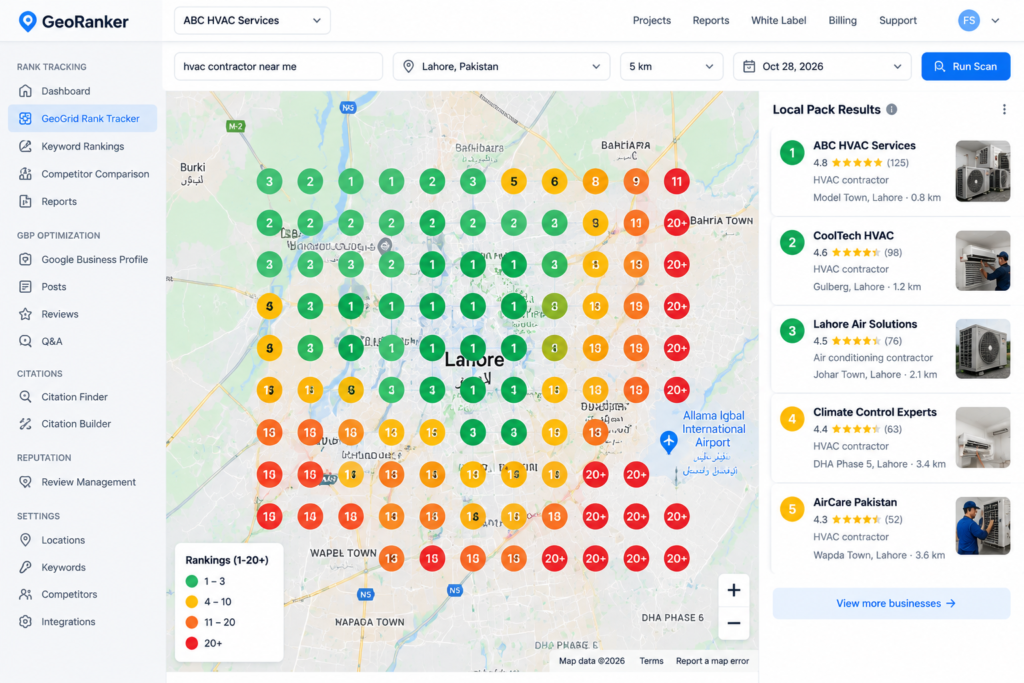
What good looks like: you track a geo-grid, not one rank check. A business can rank first outside its own door and 14th two streets away. Compare your grid each month against the three businesses actually in the pack.
How to check it:
- Run a 7×7 geo-grid scan for your main keyword. In Local Falcon this costs 49 credits.
- Mark the green zones (top 3), yellow zones (4 to 10) and red zones (not in the top 10).
- Work on the yellow zones first. They are the closest to winning.
- Repeat the same scan, same keyword and same grid size every month, so the numbers compare.
Mistake I see most: owners checking their ranking from their own office or home and thinking the whole city sees the same result.
04: Local keyword research
- Service + City Keywords
- Service + Neighborhood Keywords
- Near-Me Searches
- High-Intent Local Keywords
- Long-Tail Keywords
- Question-Based Keywords
- Competitor Keyword Gaps
- Search Intent Mapping
- Keyword Cannibalization Prevention
What good looks like: one page owns one intent. If two pages chase “plumber in [city]”, they compete with each other. Give priority to terms with clear buying intent, such as “emergency”, “cost” and service plus neighbourhood, and keep question keywords for your FAQs.
Where to find real local keywords:
- The search terms list in your Business Profile Performance report.
- Search Console queries that contain your city or area names.
- Google’s autocomplete and People Also Ask for “[service] in [city]”.
- The questions customers ask on calls and WhatsApp.
Mistake I see most: a blog post and a service page both targeting the same “service in city” keyword, so neither ranks well.
05: Local on-page SEO
- Title Tags
- Meta Descriptions
- H1 to H6 Structure
- Location-Based URLs
- Internal Linking
- Image Alt Text
- Breadcrumbs
- Local Entity Optimization
- Service Page Optimization
- Location Page Optimization
- NAP Consistency
- Conversion-Focused CTAs
What good looks like: one H1 per page with the service and location, headings in order, the city named in the first 100 words, and a call button easy to tap on mobile. Service and location pages link to each other both ways.
A simple title format that works: Service in City | Brand. For example, “Dental Implants in Lahore | Brand Name”. Keep it under about 60 characters so it does not get cut.
These basics are often the local SEO mistakes that keep a business off the map.
Mistake I see most: the homepage trying to rank for every service, with no separate service pages at all.
06: Local content SEO
- Service Pages
- Location Landing Pages
- Neighborhood-Specific Content
- Local FAQs
- Local Case Studies
- First-Hand Experience
- Expert Insights
- Original Research
- Content Freshness
- Content Pruning
- Content Decay Monitoring
- Topical Authority
What good looks like: content only you could publish: a real job in a named neighbourhood, what it cost, and photos that are yours. Pages that no longer match intent get improved, merged or removed.
What a strong service page includes:
- What the service is, in two or three plain sentences.
- Who it is for, and when they need it.
- A price range, or what changes the price.
- The steps of the job and how long it takes.
- Real photos from your own work.
- Areas you cover, named by neighbourhood.
- Three to five FAQs that customers really ask.
- One clear call to action.
Mistake I see most: stock photos on every page. Customers notice, and they give Google nothing unique about your business.
07: Technical local SEO
- Crawlability
- Indexability
- Robots.txt
- XML Sitemaps
- Canonical Tags
- Redirects
- Status Codes
- JavaScript SEO
- Duplicate Content
- Orphan Pages
- Crawl Depth
- Site Architecture
- HTTPS
- Location Page Indexation
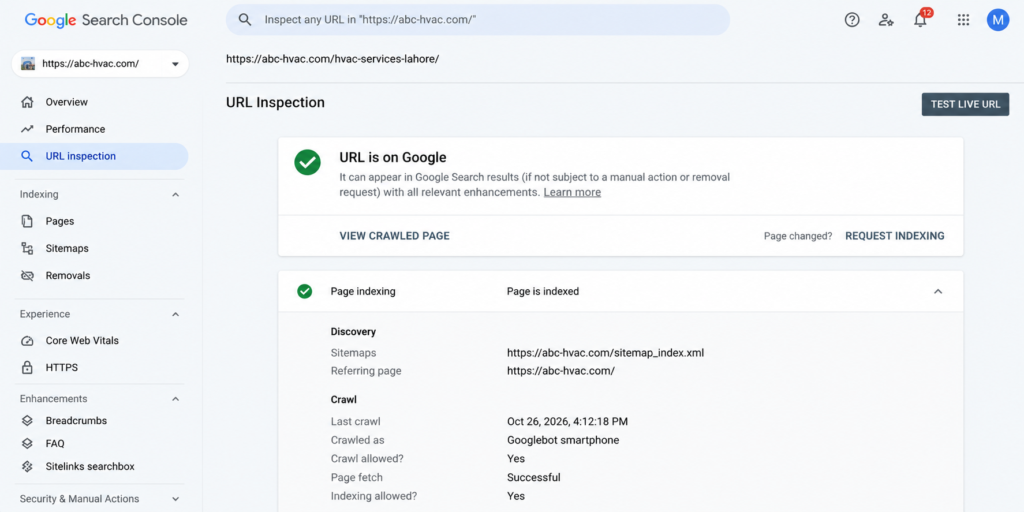
What good looks like: every location page is confirmed as indexed in Search Console. I often find them blocked by a stray noindex, missing from the sitemap or buried three clicks deep.
How to check it:
- Paste each location page into Search Console’s URL Inspection tool.
- Confirm each one is in your XML sitemap.
- Make sure each one is linked from a menu or a main page, not only from the sitemap.
- Crawl the site with Screaming Frog (free up to 500 URLs) to find broken links and redirect chains.
My list of technical SEO issues covers the fixes.
08: Website performance
- Core Web Vitals
- LCP (Largest Contentful Paint)
- INP (Interaction to Next Paint)
- CLS (Cumulative Layout Shift)
- Mobile Page Speed
- Image Optimization
- JavaScript Optimization
- Caching
- CDN (Content Delivery Network)
- Server Performance
- Mobile Usability
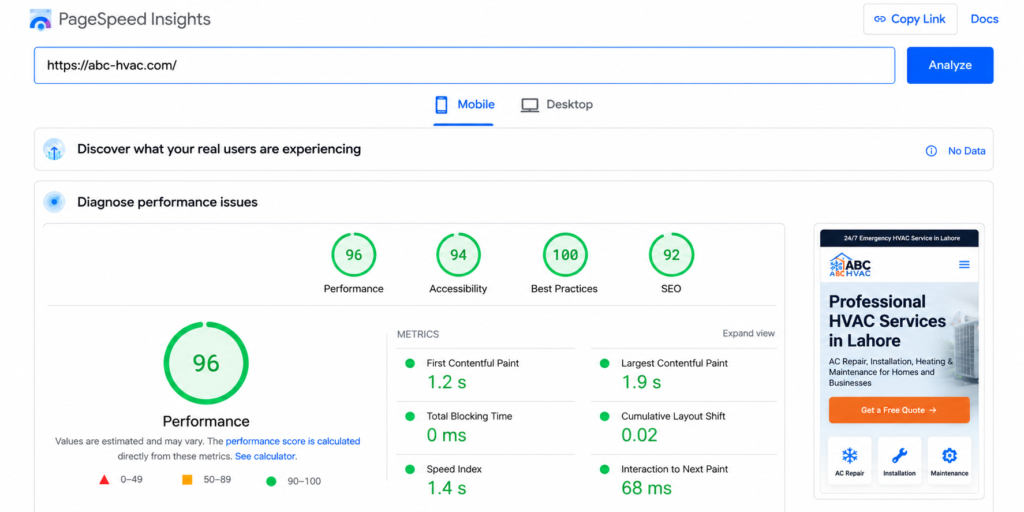
What good looks like: key pages pass Google’s Core Web Vitals on mobile: LCP under 2.5 seconds, INP under 200 milliseconds and CLS under 0.1.
Quick wins that fix most local sites:
- Convert large photos to WebP and resize them to the size they actually display.
- Remove sliders and heavy page builder add-ons you do not need.
- Turn on caching and a CDN.
- Remove chat and tracking scripts nobody uses.
Compress your real project photos instead of deleting them. You need both the trust and the speed.
09: Local business schema
- LocalBusiness Schema
- Organization Schema
- Service Schema
- PostalAddress Properties
- OpeningHoursSpecification
- GeoCoordinates
- AreaServed
- SameAs Properties
- BreadcrumbList Schema
- Review Markup Eligibility
- Schema Validation
- Structured Data Accuracy
What good looks like: schema that matches the visible page exactly, using the most specific LocalBusiness type, with zero errors in the Rich Results Test.
Properties to fill on every location:
| Property | What to put |
|---|---|
| @type | The most specific type, such as Dentist, Plumber or HVACBusiness |
| name | Same as your Business Profile |
| address | Same format as your profile and footer |
| telephone | The same number shown on the page |
| url | The location page URL |
| geo | Latitude and longitude of the location |
| openingHoursSpecification | Your real hours |
| areaServed | The areas you actually cover |
| sameAs | Your Business Profile, Facebook and other official profiles |
Do not add reviews of your own business to your LocalBusiness schema. Google treats these as self-serving and will not show review stars for them.
10: Reviews and reputation
- Google Review Acquisition
- Review Response Management
- Personalized Review Replies
- Negative Review Handling
- Customer Feedback Monitoring
- Review Sentiment Analysis
- Competitor Review Analysis
- Review Policy Compliance
- Genuine Customer Testimonials
- Reputation Monitoring
What good looks like: a direct review link sent when every job is finished, and every review answered within 48 hours. Never buy or reward reviews, as Google’s policies ban both. Compare count, rating and review speed against your top three Map Pack competitors each month.
A review process that works:
- Copy your review link from the Business Profile (“Ask for reviews”).
- Send it by WhatsApp or SMS on the same day the job is done.
- Keep the message short: thank them, add the link, say it takes one minute.
- Send one reminder after three days if there is no review. Then stop.
- Reply to every review, using the customer’s name and the service they had.
How to answer a negative review: reply calmly, thank them, say what you will do, and offer a direct phone number or email to sort it out. Do not argue in public. The reply is written for the next hundred people who read it.
11: Local citations and NAP
- Name, Address & Phone (NAP) Consistency
- Business Directory Listings
- Industry-Specific Citations
- Local Directory Submissions
- Chamber of Commerce Listings
- Citation Audits
- Duplicate Listing Cleanup
- Incorrect Business Information Correction
- Country-Specific Directories
- Citation Quality Assessment
What good looks like: one written format for your NAP, matched exactly on Google, Apple Business Connect, Bing Places, Facebook and your industry directories. Merge duplicates, and audit after any change of address, name or number.
Write your NAP once, then copy it:
- Business name exactly as on the signboard.
- Address in one fixed format, such as “Suite 4” every time, not “Ste 4” in one place and “#4” in another.
- One main phone number with the same format everywhere.
Mistake I see most: an old phone number still live on 10 or more directories after a business changed its number years ago.
12: Local link building
- Local Backlinks
- Industry-Relevant Backlinks
- Community Partnerships
- Local Sponsorships
- Chamber of Commerce Links
- Local Media Mentions
- Digital PR
- Competitor Backlink Gaps
- Unlinked Brand Mentions
- Link Reclamation
- Local Resource Page Links
What good looks like: links from local news, associations, sponsors and suppliers that know you. A directory listing is a citation, not a link strategy.
Easy local links to try first:
- Suppliers and brands you buy from, which often have “where to buy” or partner pages.
- Local events, schools or sports teams you already sponsor.
- Business groups and associations you belong to.
- Old mentions of your business with no link: ask the site to add one.
These link building strategies cover the rest.
13: Local competitor analysis
- Google Maps Competitors
- Local Pack Analysis
- Competitor GBP Categories
- Competitor Review Profiles
- Competitor Keyword Gaps
- Competitor Backlink Gaps
- Citation Gap Analysis
- Competitor Content Analysis
- Local Ranking Comparisons
- Market Opportunity Research
What good looks like: you study the three businesses Google actually shows in the Map Pack, not the rivals you assume.
Record these for each competitor:
| What to note | Why it matters |
|---|---|
| Primary and secondary categories | Shows what Google thinks they are |
| Review count and reviews in the last 30 days | Shows the pace you need to match |
| Average rating | Shows the trust gap |
| Services listed | Shows services you may be missing |
| Photo count and how recent | Shows how active the profile is |
| Website pages for each service | Shows the content gap |
The GMB Everywhere Chrome extension shows each competitor’s secondary categories, which Google does not display publicly.
14: Multi-location SEO
- Individual Location Pages
- Unique Location Content
- Location-Specific Contact Details
- Eligible GBP Profiles
- Service-Area Optimization
- Store Locator Optimization
- Location-Based Internal Linking
- Multi-Location Schema
- Duplicate Page Prevention
- Local Landing Page Indexation
What good looks like: each location has its own team, photos, reviews and directions on its page. Cloned pages with swapped city names count as doorway pages under Google’s spam policies. Each eligible location gets its own profile, citations and schema.
Simple test: if you remove the city name from a location page, could it be any of your other branches? If yes, the page needs more local detail.
15: AEO (answer engine optimization)
- Question-Based Content
- Direct Answers
- Answer-First Formatting
- Local FAQs
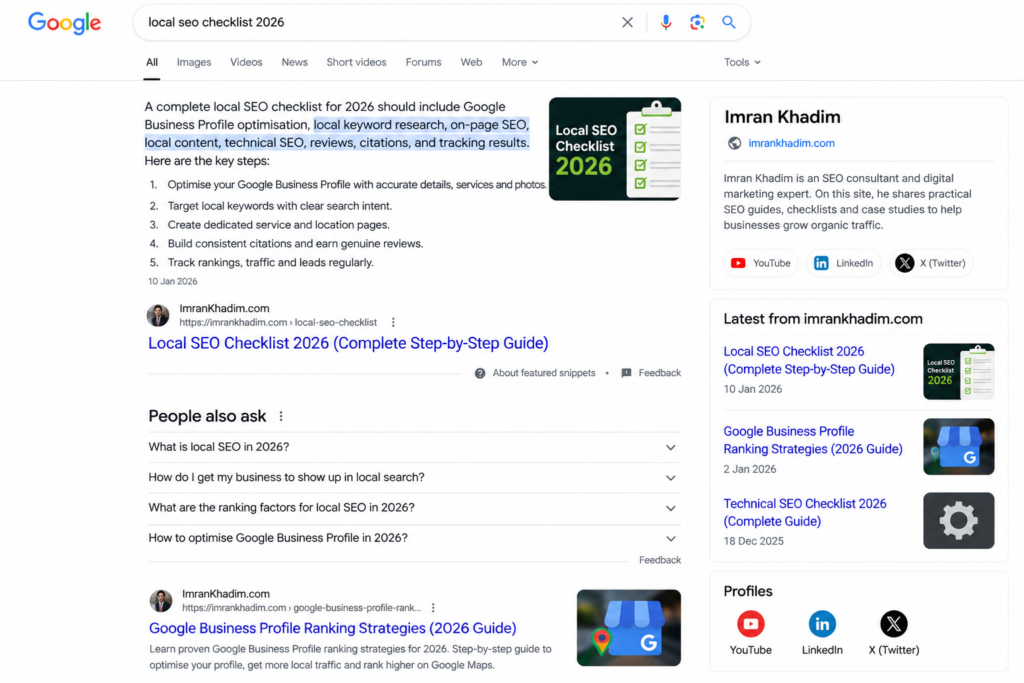
- Featured Snippet Opportunities
- Conversational Search Queries
- Entity Clarity
- Structured Information
- Evidence-Backed Claims
- Voice Search Optimization
What good looks like: each question is answered in the first two sentences under its heading, with the number or fact included. Write the way people ask out loud: “how much does it cost” or “do you cover [neighbourhood]”.
Before and after:
- Weak: “Prices depend on many factors. Contact us for details.”
- Strong: “Most AC repairs in Lahore cost between PKR 3,000 and PKR 15,000, depending on the fault and parts needed.”
(Use your own real prices in place of example figures.)
16: GEO and AI search
- Google AI Overviews
- Google AI Mode
- ChatGPT Search Visibility
- Gemini Visibility
- Perplexity Visibility
- Bing & Copilot Visibility
- Brand Mention Monitoring
- AI Citation Opportunities
- Entity Consistency
- Authoritative Local References
- Retrieval-Friendly Content
- AI Crawler Accessibility
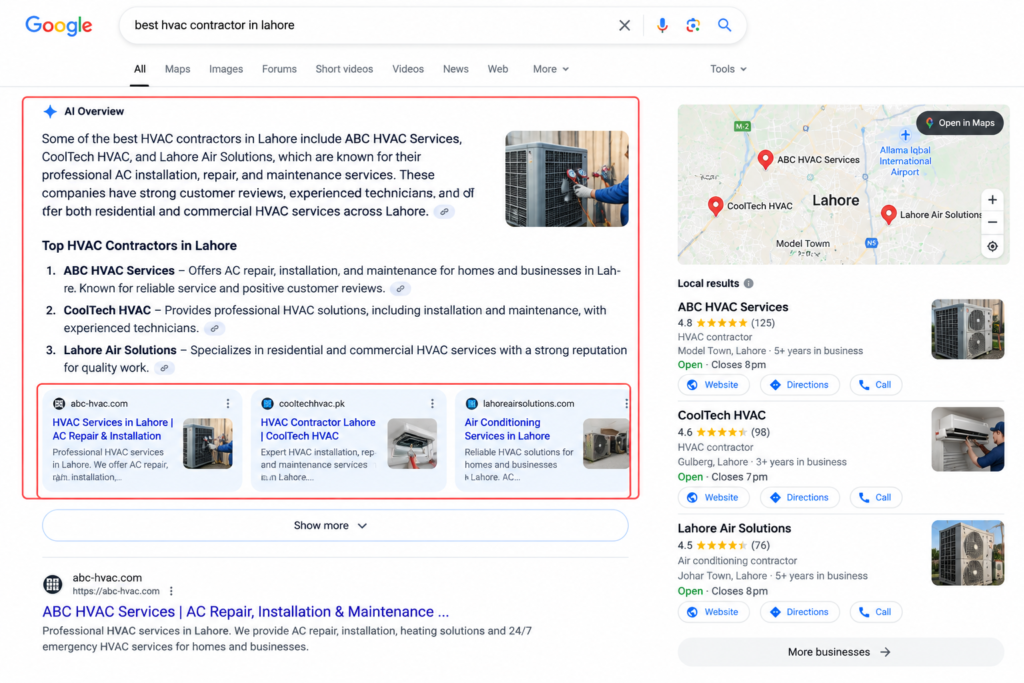
What good looks like: each quarter, ask ChatGPT, Gemini, Perplexity and AI Mode “best [service] in [city]” and record whether you are named correctly. Wrong facts usually trace back to an old profile, directory or page. Keep search crawlers such as Googlebot, Bingbot and OAI-SearchBot allowed in robots.txt.
Ask each question in a private window, and run it two or three times, because AI answers change between runs. My framework to rank in Google AI Overviews goes deeper.
17: Local SEO analytics
- Google Search Console
- Google Analytics 4 (GA4)
- Google Business Profile Performance
- Local Keyword Rankings
- Google Maps Visibility
- Calls & Website Clicks
- Direction Requests
- Qualified Leads
- Organic Conversions
- Landing Page Performance
- UTM Tracking
- Brand vs. Non-Brand Queries
- Monthly Reporting
What good looks like: a five minute monthly report you can read quickly.
| Metric | Where it comes from |
|---|---|
| Calls | Business Profile Performance, call tracking |
| Direction requests | Business Profile Performance |
| Website clicks | Business Profile Performance, GA4 with UTMs |
| WhatsApp clicks and form leads | GA4 key events |
| Geo-grid average | Your geo-grid tool |
| New reviews this month | Google Maps listing |
| Non-brand clicks | Search Console |
Note that a “call” in the profile is a tap on the call button, not a confirmed call, and a direction request is not a confirmed visit. Split brand and non-brand queries with a Search Console regex filter to see whether new customers are finding you.
18: SEO testing and automation
- Title Tag Testing
- Meta Description Testing
- Content Optimization
- Internal Link Testing
- Schema Validation
- Automated Website Crawls
- Local Rank Tracking
- Geo-Grid Monitoring
- Citation Monitoring
- Indexation Monitoring
- GSC API Integration
- GA4 Reporting Automation
- AI-Assisted SEO Analysis
What good looks like: automated crawls and rank checks that flag a dropped page or schema error in the week it happens. Change one thing at a time, then wait at least four weeks before you judge it.
My best local SEO tools roundup lists what works in each country. Some popular tools do not support Pakistan at all.
19: Local conversion optimization
- Click-to-Call Buttons
- Quote Request Forms
- Appointment Booking
- Clear Service Descriptions
- Customer Testimonials
- Trust Signals
- Real Project Photos
- Case Studies
- Mobile-Friendly CTAs
- Form Optimization
- Call Tracking
- Lead Attribution
What good looks like: on mobile, the call button shows without scrolling, forms ask only what you need, and call tracking plus UTMs show which page earned each lead. Real photos and named testimonials beat badge graphics.
Quick fixes:
- Add a WhatsApp button for markets like Pakistan, where many customers prefer it to calls.
- Cut forms down to name, phone and one message box.
- Show your phone number as tap to call in the header on mobile.
- Put reviews or a rating near the call button, not only at the bottom.
20: Local SEO business growth
- Qualified Local Leads
- Phone Call Conversions
- Appointment Bookings
- Organic Revenue
- Google Maps Leads
- Cost Per Acquisition (CPA)
- Organic Conversion Rate
- Customer Lifetime Value (CLV)
- Return on SEO Investment (ROSI)
- Location-Level Performance
- Service-Level Profitability
- Client Reporting
- Customer Retention
What good looks like: you can say what an organic lead costs, which service and location are profitable, and what a customer is worth over a year.
A simple way to work it out: divide your monthly SEO cost by the number of qualified leads from search and Maps. That is your cost per lead. Compare it with what the same lead costs from ads.
That is the standard I report against in my local SEO work.
Your 90-day order of work
| Phase | Days | Sections | Done when |
|---|---|---|---|
| Foundation | 1 to 30 | 01, 02, 07, 09, 11 | Profile complete, NAP fixed, schema valid, location pages indexed |
| Visibility | 31 to 60 | 03, 04, 05, 06, 10, 14 | Pages live, review process running, first geo-grid baseline |
| Authority and AI | 61 to 90 | 12, 13, 15, 16, 18 | First local links, AI answer check done, competitor gaps listed |
| Ongoing | Monthly | 08, 17, 19, 20 | Report read, leads counted, next fixes chosen |
Your weekly and monthly routine
| How often | Task |
|---|---|
| Every job | Send the review link |
| Weekly | Reply to reviews, add photos, post an update |
| Monthly | Geo-grid scan, analytics report, check competitor reviews |
| Quarterly | NAP and citation audit, AI answer check, schema check |
| After any change | Update profile, website, schema and directories on the same day |
The goal is not a ranking. It is being the business Google and its AI answers name, trust and make one tap to call. For a second opinion on where you stand, start with a free SEO audit.
Local SEO checklist FAQs
How long does local SEO take to show results?
Profile and on-page fixes can move Map Pack positions in two to four weeks. Reviews, citations and links build over two to six months. Google states that local ranking cannot be bought.
Do I need a website to rank locally?
You can appear on Maps with only a Google Business Profile. But a website drives local organic rankings and conversions, and it is the asset you own. You need both.
What is the most important item on this checklist?
Your profile’s primary category and completeness, then reviews. Whitespark’s Local Search Ranking Factors survey ranks Google Business Profile signals and reviews among the top factors a business controls.
Can I rank in an area where I do not have an office?
In the Map Pack, it is hard, because distance from the searcher matters. A service area business can set the areas it covers, but proximity still applies. A strong page for that area can still rank in normal search results.
How often should I work through this checklist?
Build sections 1 to 11 once and audit them quarterly. Handle reviews and photos weekly, and analytics and AI checks monthly.
Should I do local SEO myself or hire someone?
Everything here is doable yourself. Hire help when your time costs more than the fee, when a suspension is involved, or when competitors keep outranking you. Read how to hire an SEO expert before you choose.

2 Comments