

Google Ads has no fixed price in Pakistan. You set your own budget and pay each time someone clicks your ad. In 2026, Pakistani agencies report clicks costing roughly PKR 20 to 150 for e-commerce and local services, and PKR 150 to 800 for real estate, healthcare, education and B2B. Most small businesses test with PKR 30,000 to 100,000 a month in ad spend, plus about 5 to 7 percent in taxes and bank charges on card payments.
How Google Ads pricing works
Google Ads is an auction. Every time someone searches, Google decides which ads to show and in what order, then charges the advertiser only when the ad is clicked (for Search campaigns). There is no monthly fee to Google and no minimum spend.
The auction and Ad Rank
Your position is decided by Ad Rank, not by bid alone. Google combines your bid with the quality of your ad and landing page, the search context and the expected effect of your ad assets (such as call buttons and sitelinks).
This is why a small clinic with a well-built ad can appear above a bigger competitor bidding more.
What you actually pay per click
Your maximum bid is the most you are willing to pay. The actual cost per click (CPC) is usually lower. Google charges only what is needed to keep your position above the advertiser below you and to clear the minimum Ad Rank threshold.
Quality Score
Quality Score is a 1 to 10 rating Google shows for each keyword. It is based on three things:
- Expected click-through rate: how likely people are to click your ad
- Ad relevance: how closely the ad matches the search
- Landing page experience: how useful and fast the page is after the click
A higher Quality Score usually means lower CPCs for the same position. It is the main lever a small advertiser has against bigger budgets.
Average cost per click in Pakistan by industry
Google does not publish country-level CPCs. The figures below combine ranges published in 2026 by Pakistani advertising agencies from campaigns they manage. Treat them as starting estimates, then check your own keywords in Google Keyword Planner before setting a budget.
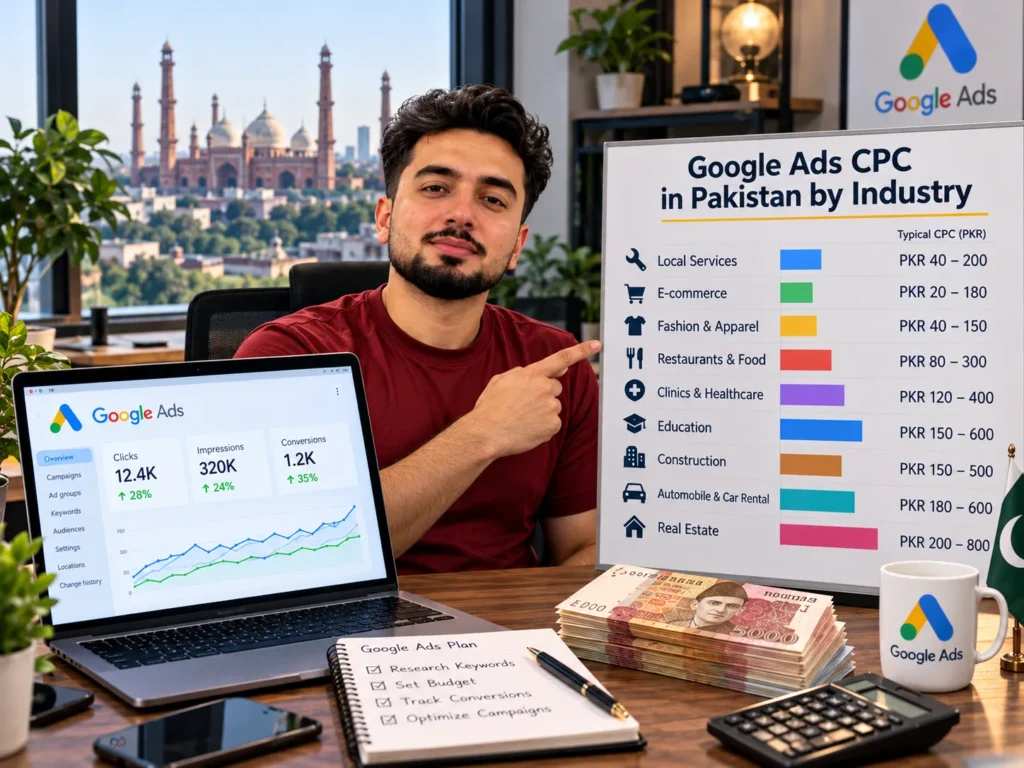
| Industry | Typical CPC (PKR) | Typical monthly ad spend (PKR) |
|---|---|---|
| Local services (plumbers, cleaners, repairs) | 40 to 200 | 30,000 to 150,000 |
| E-commerce and online stores | 20 to 180 | 40,000 to 250,000 |
| Fashion and apparel | 40 to 150 | 150,000 to 500,000 |
| Restaurants and food | 80 to 300 | 100,000 to 600,000 |
| Clinics and healthcare | 120 to 400 | 30,000 to 800,000 |
| Education (schools, courses, study abroad) | 150 to 600 | 200,000 to 800,000 |
| Construction | 150 to 500 | 60,000 to 200,000 |
| Automobile and car rental | 180 to 600 | 300,000 to 1,200,000 |
| Real estate | 200 to 800 | 80,000 to 1,000,000 |
Some context on these numbers:
- They are wide on purpose. A “dentist near me” search in DHA Lahore and the same search in Sahiwal can differ several times over in price.
- High-intent keywords cost more. “Dental implant cost Lahore” is worth more to advertisers than “how to whiten teeth”.
- Pakistan is cheap by global standards. WordStream’s 2025 benchmarks for US search campaigns put the average CPC at $5.26, roughly PKR 1,470, with dentists at $7.85. Most Pakistani clicks cost a fraction of that.
Clinics often find that a strong Google Business Profile brings calls from the map results that would otherwise cost PKR 200 or more per click. That is the main reason dental SEO and paid search work well together.
Google Ads cost by campaign type
Not every campaign type is billed the same way. The type you choose changes how you pay and how much each result costs.
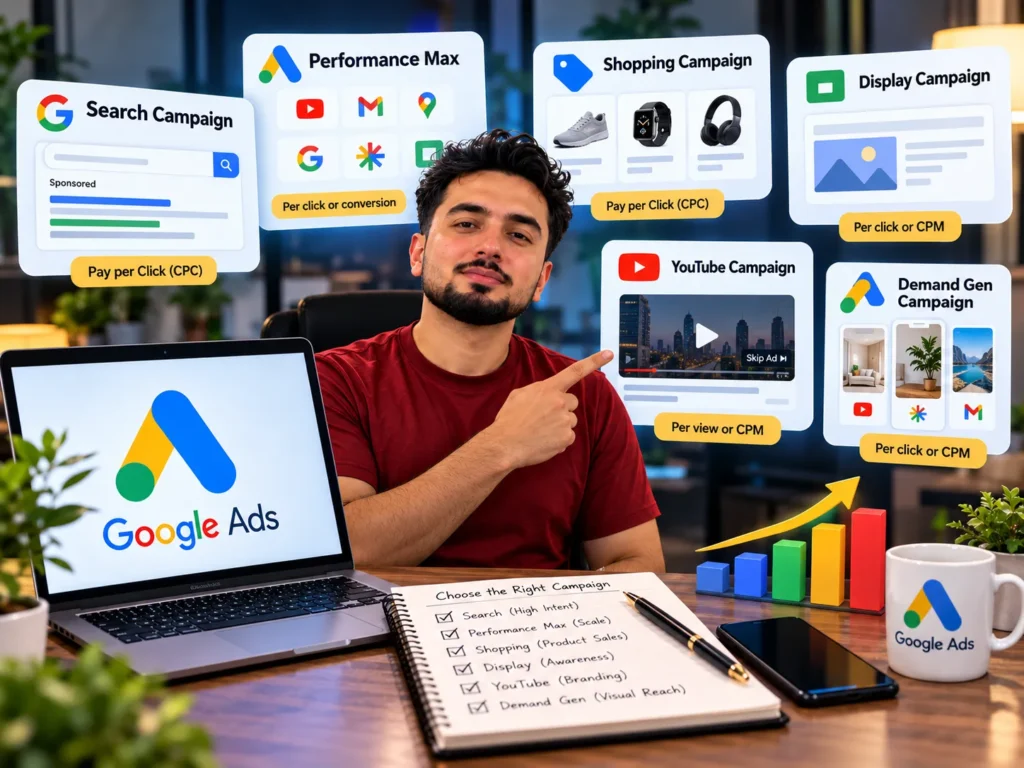
| Campaign type | How you are charged | What it is good for | Cost note |
|---|---|---|---|
| Search | Per click (CPC) | Calls, enquiries, bookings from people searching now | Highest intent, usually the best starting point |
| Performance Max | Per click or conversion bidding across Google | Online stores and lead generation at scale | Needs conversion tracking and enough data to work well |
| Shopping | Per click | Product sales with images and prices | Needs a Google Merchant Center feed |
| Display | Per click or per 1,000 impressions (CPM) | Awareness and remarketing | Cheap clicks, low intent |
| YouTube (Video) | Per view or per 1,000 impressions | Brand awareness, demonstrations | Views are cheap, but not leads |
| Demand Gen | Per click or per 1,000 impressions | Visual ads on YouTube, Discover and Gmail | Better for awareness than direct sales |
For a local business with a small budget, a Search campaign with tight keywords is usually where the money goes furthest. Shopping and Performance Max make more sense once an online store has a clean product feed and properly set up e-commerce SEO foundations, because the same product data feeds both.
What makes clicks cost more or less in Pakistan
Two advertisers in the same industry can pay very different CPCs. These factors explain most of the gap.
- City and area. Karachi, Lahore and Islamabad are the most competitive. Targeting a 5 km radius instead of a whole city often lowers cost per lead.
- Keyword intent. Searches with “price”, “near me”, “book” or “best” in them attract more bidders.
- Match type. Broad match reaches more searches, including irrelevant ones. Phrase and exact match keep spend on the searches you want.
- Quality Score. Weak ads and slow landing pages push your CPC up for the same position.
- Season. Ramadan and Eid, wedding season, back-to-school months and White Friday sales all raise competition in their categories. Rent-a-car businesses feel this most around Eid and the summer travel months, which is why rental car SEO pages need to rank before the peak arrives.
- Device. Most Pakistani searches happen on phones. A landing page that is slow or hard to use on mobile wastes paid clicks; mobile SEO fixes help ads and organic results at the same time.
- Time of day. Running ads only during business hours, when someone can answer the phone, cuts wasted spend.
- Language. Roman Urdu and Urdu searches often have fewer advertisers, so clicks can be cheaper if your ads and landing pages speak the same way.
How to set a Google Ads budget in Pakistan
The right budget starts from the number of customers you want, not from a round figure. Work backwards in four steps.
- Find your likely CPC. Use Keyword Planner or the ranges above for your industry and city.
- Estimate your conversion rate. For lead generation in Pakistan, agencies report 2 to 8 percent of clicks turning into a call or form. Use 3 to 5 percent if you have no data yet.
- Work out your cost per lead. Cost per lead = CPC ÷ conversion rate.
- Multiply by the leads you want each month.
Worked example: a clinic in Lahore expects a CPC of PKR 150 and a 5 percent conversion rate. Its cost per lead is PKR 3,000 (150 ÷ 0.05). For 30 enquiries a month, the clinic needs about PKR 90,000 in ad spend, which buys roughly 600 clicks.
| Goal | Monthly ad spend that usually fits | What to expect |
|---|---|---|
| Test whether ads work for you | PKR 30,000 to 50,000 | Enough clicks to learn which keywords convert, not enough to scale |
| Steady leads for one location | PKR 50,000 to 150,000 | Consistent calls and forms in most service industries |
| Several branches or competitive niche | PKR 150,000 to 500,000 | Coverage across areas, keywords and campaign types |
| Online store scaling sales | PKR 250,000 and above | Shopping and Performance Max with enough data to optimise |
If a budget cannot buy at least 150 to 200 clicks in a month, the results will be too thin to judge. Either narrow the targeting or raise the budget.
How Google spends your daily budget
Google Ads works with an average daily budget. Two rules surprise most new advertisers:
- Some days Google can spend up to twice your daily budget, when it sees more searches that are likely to convert.
- Over a month, you will not be charged more than 30.4 times your daily budget.
To spend PKR 30,000 in a month, set a daily budget of about PKR 990 (30,000 ÷ 30.4). Changing the budget often, or pausing and restarting campaigns, makes this harder to predict.
The full cost of running Google Ads in Pakistan
Ad spend is the biggest cost, but it is not the only one. Budget for all of these before you start.
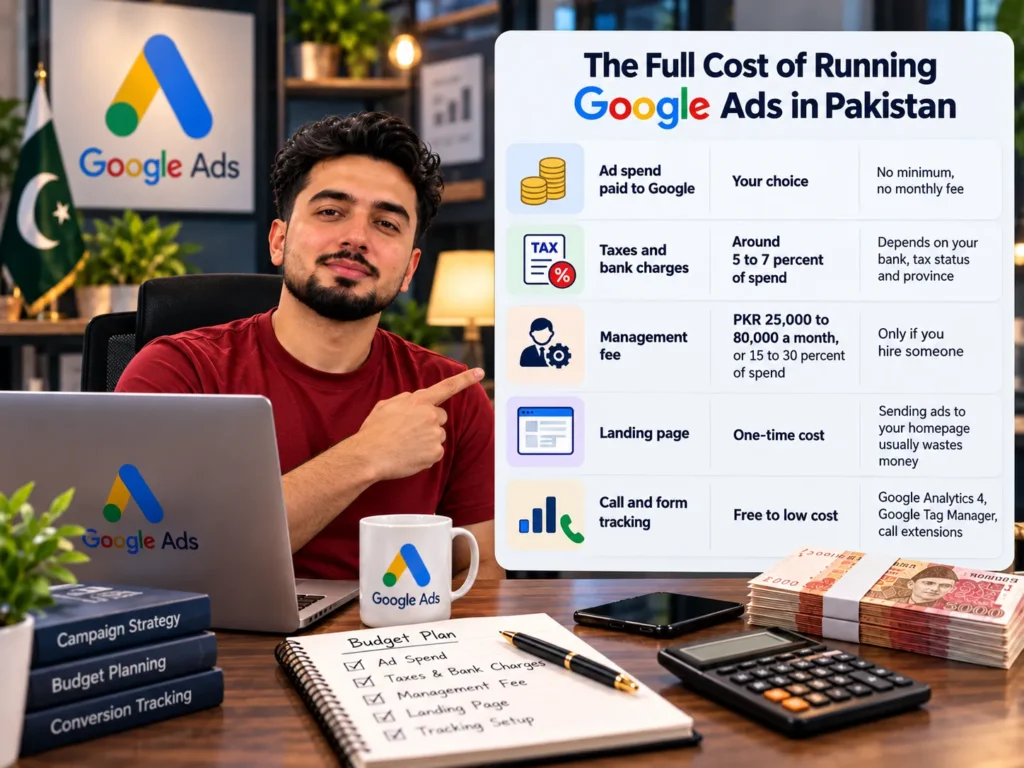
| Cost item | Typical amount | Notes |
|---|---|---|
| Ad spend paid to Google | Your choice | No minimum, no monthly fee |
| Taxes and bank charges | Around 5 to 7 percent of spend | Depends on your bank, tax status and province |
| Management fee | PKR 25,000 to 80,000 a month, or 15 to 30 percent of spend | Only if you hire someone |
| Landing page | One-time cost | Sending ads to your homepage usually wastes money |
| Call and form tracking | Free to low cost | Google Analytics 4, Google Tag Manager, call extensions |
Taxes and bank charges on Google Ads payments
Most Pakistani advertisers pay Google with a debit or credit card in a foreign currency. Several deductions can apply to each payment:
- Advance income tax on foreign currency card payments, collected by your bank. Active taxpayers pay a much lower rate than non-filers, so being on the Active Taxpayers List matters.
- Provincial sales tax withholding, which some banks deduct on payments for IT and advertising services.
- Bank foreign exchange spread and processing charges, which vary by bank.
- Withholding on offshore digital services. Google’s own tax help page notes a 5 percent tax on payments for its offshore digital services in Pakistan, made since 1 July 2018.
One Pakistani business that published its statement breakdown in 2026 reported total deductions of about 6.3 percent on PKR 100,000 of Google Ads spend. Your figure may differ, so check a recent card statement and ask your accountant whether any of it can be claimed back.
Management fees
If you hire someone to run your ads, Pakistani agencies and freelancers typically charge a flat monthly fee or a percentage of ad spend. On small budgets a flat fee is usually cheaper; on large budgets a percentage can grow quickly, so agree a cap.
Paying for Google Ads from Pakistan
Setting up billing takes a few minutes, but two choices are hard to undo.
- Account currency. You pick it when you create the account, PKR or USD for most Pakistani advertisers. It cannot be changed later without opening a new account.
- Payment method. Most advertisers use a Visa or Mastercard debit or credit card with international payments enabled. Google shows the payment options available for your country and currency during setup.
- Payment setting. Automatic payments charge your card after costs build up or on a monthly date. Manual payments, where offered, let you top up in advance.
- Invoices and receipts. Download monthly statements from the Billing section for your records and tax filing.
Before your first campaign, call your bank to confirm international card payments are active and ask about the limits on your card.
Where Pakistani businesses waste Google Ads money
Most overspending comes from a handful of settings, not from high CPCs.
- No conversion tracking. Without it, Google cannot tell good clicks from bad ones, and smart bidding has nothing to learn from.
- Broad match with no negative keywords. Ads show for “free”, “jobs”, “course” and “how to” searches that never buy.
- Search campaigns opted into the Display Network. This is switched on by default in some setups and sends low-intent clicks.
- Location set to “presence or interest”. People outside your city who show interest in it can see your ads. “Presence” only is safer for local businesses.
- Ads sending traffic to the homepage. A page built for the exact service in the ad converts far better.
- Ads running all night. If nobody answers calls after 8pm, ads that run after 8pm waste money.
A landing page that matches the search also improves Quality Score, which lowers CPC. The same page-level work is what on-page SEO improves for organic rankings.
When Google Ads is worth the cost
Google Ads pays off when the value of a customer is clearly higher than the cost of getting one. A quick check:
- Work out the profit from one average customer, not the sale price.
- Divide it by your expected cost per lead, then by how many leads you need to win one customer.
- If one customer covers the ad cost of winning them with room to spare, ads are worth testing.
Ads work best for urgent needs, new businesses that do not rank yet and seasonal offers. They stop the moment the budget does. Organic results keep bringing visits after the work is done, which is why many businesses run ads while local SEO builds up their map pack and website rankings. For organic budgets, see my breakdown of SEO cost in Pakistan.
Frequently asked questions
What is the minimum budget for Google Ads in Pakistan?
Google has no minimum. In practice, PKR 30,000 a month is a sensible starting point for a test, because smaller budgets rarely buy enough clicks to show which keywords bring customers.
How much does one click cost on Google Ads in Pakistan?
Most clicks cost between PKR 20 and 800. E-commerce and local services sit at the low end, while real estate, education and healthcare sit at the high end. Your exact CPC depends on keywords, city, competition and Quality Score.
Does Google charge a monthly fee for Ads?
No. Google charges only for clicks, views or impressions, depending on campaign type. Any monthly fee you pay goes to an agency or freelancer for managing the account, not to Google.
Are there taxes on Google Ads payments in Pakistan?
Yes. Card payments in foreign currency can attract advance income tax, provincial sales tax withholding and bank charges. Together these often add around 5 to 7 percent to your spend. Filers pay less than non-filers.
Is Google Ads more expensive than Facebook Ads in Pakistan?
Google clicks usually cost more than Facebook or Instagram clicks, but they come from people actively searching for a product or service. For urgent services, Google often costs less per customer even when the click is more expensive.
How long before Google Ads shows results?
Ads start showing within hours of approval. Getting a profitable cost per lead usually takes four to eight weeks of testing keywords, ads and landing pages.
Can I run Google Ads for a few days only?
Yes. You can set start and end dates and pause at any time. Short campaigns work for sales and events, but they give little time to improve results.