
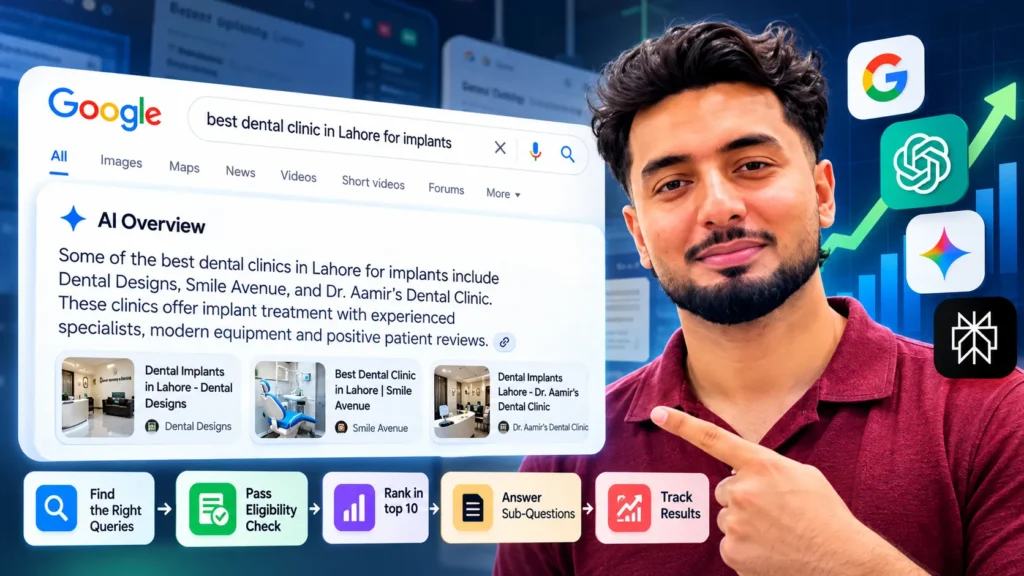
To rank in Google AI Overviews, a page must first be indexed and eligible to show a snippet, which is Google’s only stated requirement. Then it needs to rank well for the main query, because Ahrefs found 76% of AI Overview citations come from top 10 pages. After that, cover the related sub-questions Google searches through “query fan-out”, and answer each one in a short, direct block under a clear heading, backed by specific facts. Track progress by checking your target queries by hand or with a rank tracker that records AI Overview citations.
How a page ends up as an AI Overview citation
An AI Overview is not a separate search engine. It is built on top of Google’s normal index, in roughly four stages:
- Index: Google crawls and stores your page as usual.
- Retrieval: for the user’s query, Google runs the main search plus several related searches. Google calls this query fan-out.
- Selection: Gemini reads the retrieved pages and picks passages that answer parts of the question.
- Citation: the passages it used are shown as links beside the answer.
A failure at any stage ends the process. A page that is not indexed never gets retrieved. A page that ranks but answers vaguely is retrieved but not selected. The eight steps below map onto these four stages.
This guide is the hands-on version. If you want the wider picture first, covering ChatGPT, Perplexity and brand building, read my AI search strategy guide.
Step 1: Find the queries that already show an AI Overview
Do not optimise blindly. Many searches never show an AI Overview, so start by finding the ones that do.
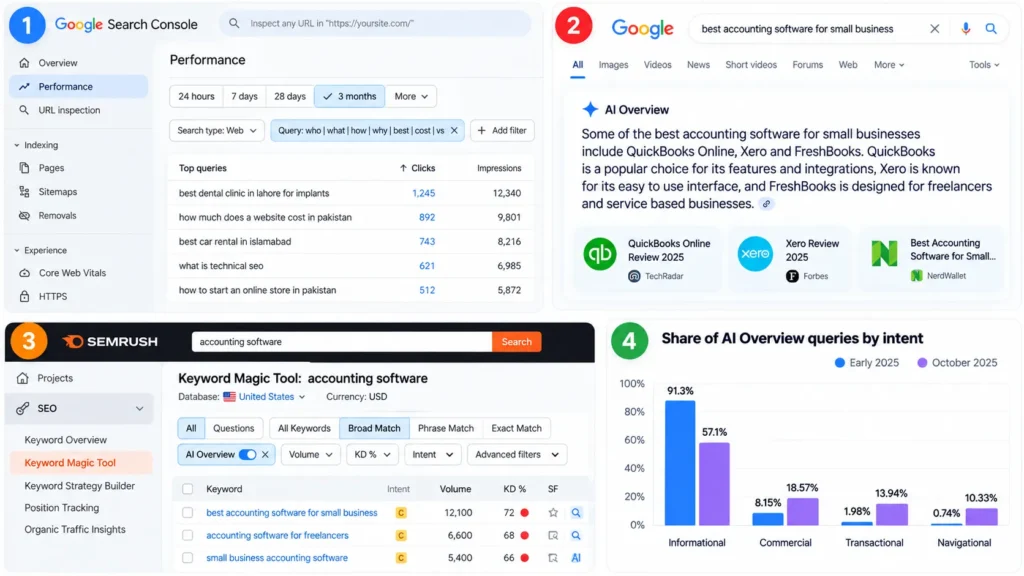
Semrush’s study of more than 10 million keywords found that the share of queries showing an AI Overview peaked at 24.61% in July 2025 and was 15.69% in November 2025. The mix of intent has also widened:
| Query intent | Share of AI Overview queries, early 2025 | Share, October 2025 |
|---|---|---|
| Informational | 91.3% | 57.1% |
| Commercial | 8.15% | 18.57% |
| Transactional | 1.98% | 13.94% |
| Navigational | 0.74% | 10.33% |
So AI Overviews are no longer only a “what is” problem. Commercial searches such as “best accounting software for small business” now show them too.
The same study found nearly 60% of AI Overview keywords get 100 or fewer searches a month. These are long, specific questions, which is good news for smaller sites.
How to build your list:
- In Search Console, filter Performance by queries containing who, what, how, why, best, cost or vs.
- Search the top 30 in a private window, set to your target country, and note which show an AI Overview.
- In Semrush or Ahrefs, filter your keywords by the “AI Overview” SERP feature.
- Record which sites are cited today. Those are the pages you need to beat.
Industry matters too. Semrush found science and computers and electronics had the highest AI Overview share in November 2025, while real estate and shopping sat below 3%.
Step 2: Pass the eligibility check
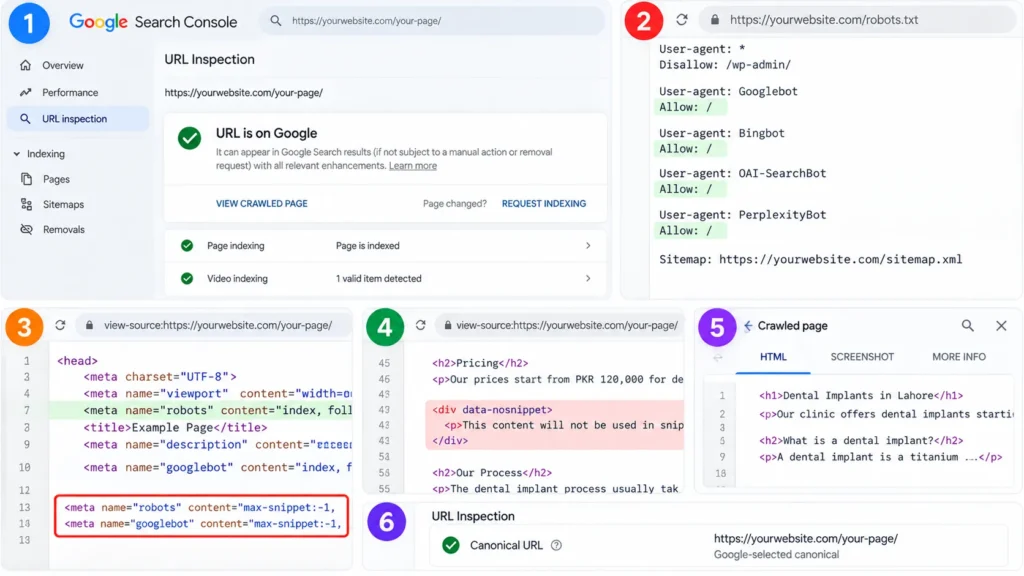
Google’s documentation says a page must be “indexed and eligible to be shown in Google Search with a snippet” to appear as a supporting link. There are no other technical requirements. That makes this step a simple pass or fail.
| Check | Where to check | Pass condition |
|---|---|---|
| Page is indexed | Search Console, URL Inspection | “URL is on Google” |
| Not blocked from crawling | robots.txt, URL Inspection | Googlebot allowed |
| Snippet allowed | Page source, HTTP headers | No nosnippet; max-snippet not set to 0 |
| Key text not hidden from snippets | Page source | Main answer not wrapped in data-nosnippet |
| Content visible after rendering | URL Inspection, “View crawled page” | Answer text appears in the rendered HTML |
| Correct canonical | URL Inspection | Google-selected canonical matches yours |
Watch for snippet controls added by plugins
Some SEO plugins and themes add max-snippet or nosnippet settings without the owner noticing. A small max-snippet value limits how much text Google can show, and Google says these same controls limit what appears in AI features.
Make sure the answer is in the HTML
If your answer loads only after a user clicks a tab or runs a script, check the rendered HTML in URL Inspection. Text that Google cannot render cannot be quoted.
When a page fails the indexing check, my guide on why a website is not showing on Google walks through each cause.
Step 3: Rank in the top 10 for the main query
Ahrefs studied 1.9 million citations from 1 million AI Overviews, published in July 2025. It found:
- 76.1% of cited pages ranked in the top 10 for that query.
- 9.5% ranked between positions 11 and 100.
- 14.4% did not rank in the top 100 at all.
- The first cited URL had a median ranking position of 2.
So normal ranking work is still the biggest lever. If your page sits on page three, fix that before anything else. The basics still apply: a title that matches the query, a clear heading structure, internal links and content that fully answers the search. These on-page SEO factors cover them in order of impact.
The 14.4% from outside the top 100 is the interesting part. Those pages were most likely picked up through fan-out searches, not the main query. That is what Step 4 targets.
Step 4: Map the query fan-out
When someone searches “dental implant cost in Lahore”, Google may also search for implant types, number of visits, healing time and payment options. Pages that answer those sub-questions can be cited even if they do not rank for the main query.
You cannot see Google’s fan-out queries directly. But you can predict most of them from four places:
- People Also Ask: Semrush found PAA boxes on about 90% of results pages that show an AI Overview.
- Related searches: shown on about 95% of AI Overview results pages.
- The AI Overview itself: its bold phrases and subheadings show which sub-topics Google grouped.
- AI Mode follow-ups: ask the query in AI Mode and note the follow-up suggestions.
Example fan-out map
| Main query | Likely sub-questions | Where it goes on the page |
|---|---|---|
| Dental implant cost in Lahore | Price range by implant brand | H2 with a price table |
| How many visits are needed | H3 with a numbered timeline | |
| Is it painful | H3 with a short answer | |
| Payment plans or instalments | H3 with clinic policy | |
| Implant vs bridge cost | H2 with a comparison table |
Each sub-question gets its own heading. Group them on one strong page instead of creating thin separate pages for each. Google’s own guidance says its systems understand several topics on one page, so you do not need to split them up.
Step 5: Write answer blocks Google can lift
An answer block is a heading followed by a direct reply in the first one or two sentences, then the detail. It is how good reference writing has always worked, and it suits AI Overviews because Gemini selects passages, not whole pages.
The structure
- Heading as the question, in the words people search.
- Direct answer first, in roughly 40 to 60 words.
- Supporting detail, such as conditions, exceptions and reasons.
- A list or table where the content is steps, options or numbers.
- A specific fact, such as a price, date, measurement or result.
Before and after
Weak: “Implant costs depend on many factors, and every patient is different. Contact us to learn more about our affordable options.”
Strong (example figures): “A single dental implant in Lahore usually costs between PKR 100,000 and PKR 250,000 in 2026. The price depends on the implant brand, whether a bone graft is needed, and the crown material. Most treatments take two visits about three months apart.”
The strong version answers the question, gives a range and names the factors. The weak version gives Gemini nothing to quote.
Replace the example figures with your own verified prices. A wrong number in an answer block hurts trust more than no number at all.
Keep blocks self-contained
Each block should make sense if it is read alone. Avoid openings like “As mentioned above” or “This is why”. If a passage depends on earlier text, it is harder to quote correctly. A structured content optimization pass usually fixes this across a whole site.
Step 6: Add proof that makes your passage the safer choice
When several pages say roughly the same thing, Google has to pick one. Pages with clear signs of first-hand experience and accuracy give it a reason to pick yours.
- Named author with real credentials, linked to an author page.
- Visible “updated” date, and content that is actually updated.
- Original data, such as your own prices, test results or client numbers.
- Sources for claims, linked to the original study or official page.
- Consistent facts across your site, Google Business Profile and directories.
For example, on one SaaS project my team rebuilt comparison and feature pages with real product data and plain answers. That work contributed to 455,000 impressions in AI results within three months.
Mentions on other trusted sites also help Google trust a source. Most of the tactics in my list of link building strategies earn those mentions as well as links.
Step 7: Use structured data the right way
Google says no special schema is needed for AI Overviews. It also says structured data must match the visible text on the page. Schema helps Google confirm facts; it does not replace them.
| Schema type | Use it for | Note |
|---|---|---|
| Article | Blog posts and guides | Include author and dates |
| Organization | Your brand facts | Name, logo, social profiles |
| LocalBusiness | Clinics, shops, offices | Address, hours, phone |
| Product | Store product pages | Price and availability must match the page |
| FAQPage | Real FAQ sections | Since August 2023, FAQ rich results show mainly for government and health sites, but the markup still describes the content |
| BreadcrumbList | Site structure | Helps Google understand page hierarchy |
Do not add schema for content that is not on the page. Marking up hidden FAQs or fake reviews breaks Google’s structured data rules.
Step 8: Measure AI Overview visibility
Search Console includes AI Overview data inside the Web search type of the Performance report, but it does not show it separately. So you need a mix of methods:
- Manual checks: search your 20 to 30 target queries every two weeks in a private window and record whether you are cited.
- Rank trackers with AI Overview tracking: Semrush Position Tracking and Ahrefs Rank Tracker both flag AI Overviews and whether your site is cited.
- The impressions pattern: in Search Console, a page whose impressions rise while CTR falls often appears in an AI Overview above the normal results.
- Branded search: rising searches for your brand name can follow repeated AI Overview mentions.
Track citations, not just rankings. A page at position 4 that is cited in the AI Overview may get more attention than the page at position 1.
Should you block your pages from AI Overviews?
You can. Adding nosnippet or a very small max-snippet limits what Google shows from your page in both normal snippets and AI features. Using noindex removes the page from search entirely.
The cost is high. Blocking snippets also weakens your normal search listing. For most businesses, being cited is worth more than being hidden.
Note that Google-Extended, the robots.txt control for Gemini training, does not control AI Overviews. Only the snippet controls and noindex do.
How AI Mode changes the picture
AI Mode is Google’s separate, chat style search tab. It uses the same index but runs more fan-out searches and handles follow-up questions.
For pages, the effect is that sub-question coverage matters even more. AI Mode often answers three or four related questions in one response, each with its own sources.
For Pakistani sites, both features are already live. AI Overviews added Urdu support in May 2025, when Google expanded them to more than 200 countries and 40 languages. AI Mode launched in Pakistan in English in August 2025. If you write in Urdu as well as English, both versions can be cited.
Why a page that ranks still does not get cited
These are the most common reasons I find in audits:
- The answer is buried. The page ranks for the query but the direct answer sits in paragraph six.
- The page is generic. It says the same as every other result, so a better known site gets picked.
- Snippet limits. A plugin set
max-snippettoo low. - The answer is in an image. Text inside an infographic or screenshot cannot be quoted.
- Rendering problems. Content loads with JavaScript that Googlebot did not render, one of the most common technical SEO issues on modern sites.
- Out of date facts. An old price or rule loses to a page updated this year.
- Wrong intent. A sales page competes against guides for an informational query.
The framework on one page
| Step | Goal | Main action | Done when |
|---|---|---|---|
| 1 | Pick targets | List queries that show AI Overviews | 20 to 30 queries recorded |
| 2 | Eligibility | Check indexing and snippet controls | All pages pass |
| 3 | Ranking | Improve pages to reach the top 10 | Main pages on page one |
| 4 | Fan-out | Map sub-questions from PAA and related searches | Each sub-question has a heading |
| 5 | Answer blocks | Rewrite sections answer first | Every block stands alone |
| 6 | Proof | Add authors, dates, data and sources | Claims are specific and sourced |
| 7 | Schema | Add matching structured data | No errors in the Rich Results Test |
| 8 | Measure | Track citations every two weeks | Trend recorded over 90 days |
If you would rather have this done for you, my AI search optimisation service runs this framework with monthly citation reports.
Frequently asked questions
Can you pay to appear in Google AI Overviews?
No. AI Overview citations cannot be bought. Google Ads can appear above or below an AI Overview, and Semrush found ads at the bottom of about 25% of AI Overview results pages, but those are labelled ads, not citations.
Do I need to rank number one to be cited in an AI Overview?
No, but it helps. Ahrefs found the first cited URL had a median position of 2, and 76% of cited pages ranked in the top 10. About 14% ranked outside the top 100, usually because they answered a related sub-question.
How long does it take to get into an AI Overview?
For a page already in the top 10, a clearer answer block can be picked up after Google recrawls it, often within a few weeks. For a page that first needs to reach the top 10, expect the same timeline as normal ranking work, which is usually several months.
Does schema markup help with AI Overviews?
Not directly. Google says no special schema is needed. Structured data still helps Google understand facts like prices, authors and addresses, as long as it matches the visible content.
Why does my AI Overview citation keep disappearing?
AI Overviews are generated fresh and can change between searches, users and days. Google may also stop showing an AI Overview for a query. Track citations over several weeks rather than reacting to a single check.
Do AI Overviews show in Pakistan?
Yes. Google expanded AI Overviews to more than 200 countries and over 40 languages, including Urdu, in May 2025. AI Mode has been available in Pakistan in English since August 2025.