
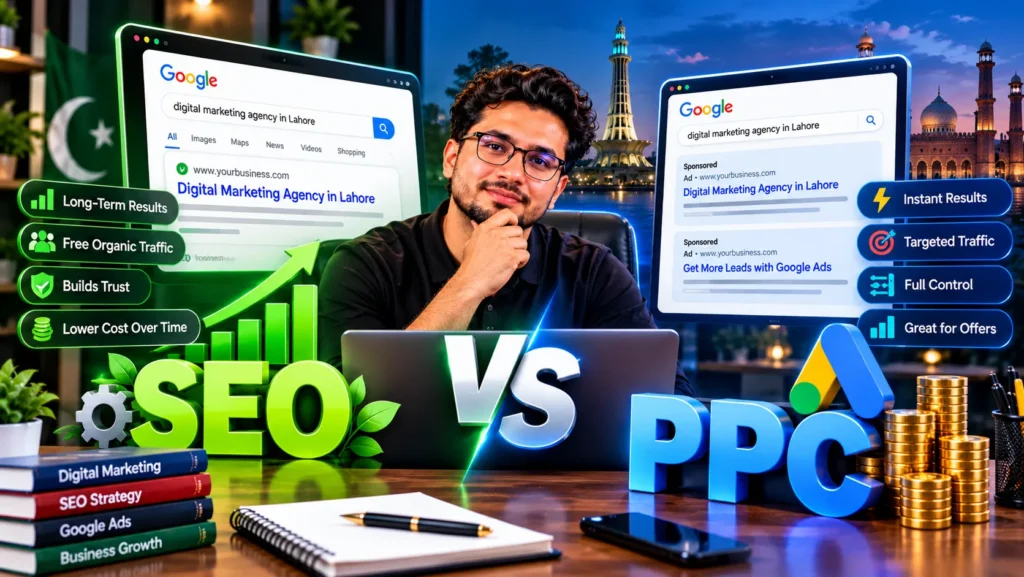
Neither SEO nor PPC is better for every business. PPC (paid ads such as Google Ads) brings visitors within hours and suits new businesses, short offers and urgent services, but traffic stops the day you stop paying. SEO takes months to build but keeps bringing visitors without a cost per click, which makes it cheaper over time for businesses that plan to be around for years. Most Pakistani businesses do best starting with PPC for quick leads while SEO builds, then shifting budget towards SEO as organic rankings grow.
SEO and PPC in one sentence each
SEO (search engine optimisation) is the work of improving your website so it appears in Google’s free, organic results and map listings.
PPC (pay per click) is advertising where you pay each time someone clicks your ad. On search engines this mainly means Google Ads and Microsoft Ads; the term is also used for paid clicks on Facebook, Instagram, TikTok and YouTube.
This comparison focuses on search: SEO and Google Ads both target people who are actively searching for something, which is why business owners usually choose between them.
SEO vs PPC: side-by-side comparison
| Factor | SEO | PPC (Google Ads) |
|---|---|---|
| How you pay | Time, content and expert fees; no charge per click | Every click, plus management fees if you hire help |
| Speed to first results | Usually 3 to 6 months; local map results can move sooner | Hours after the ad is approved |
| When you stop spending | Rankings fade slowly, often over months | Traffic stops immediately |
| Cost per visitor over time | Falls as rankings grow | Stays the same or rises with competition |
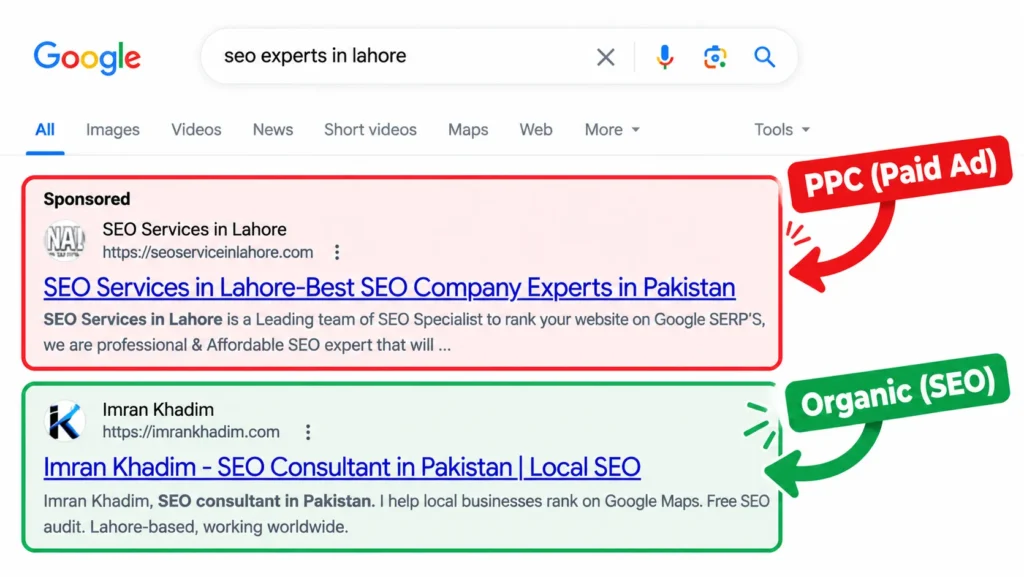
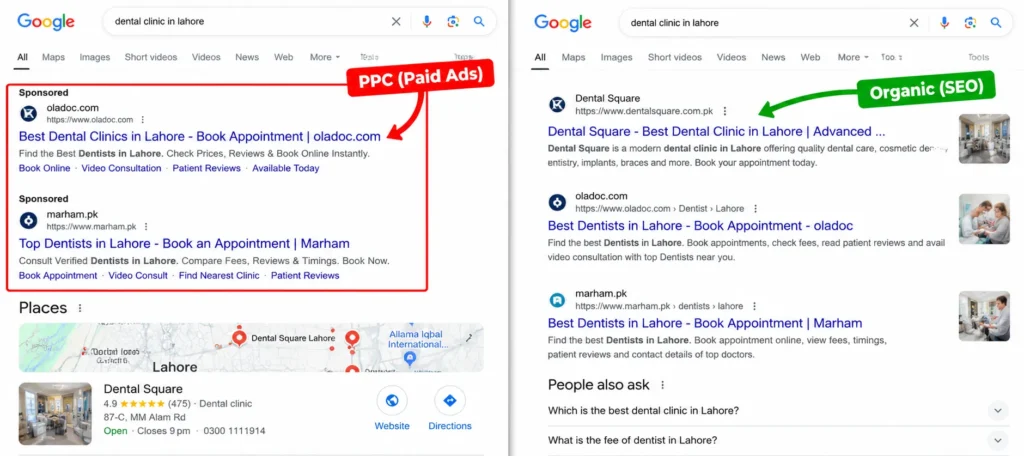
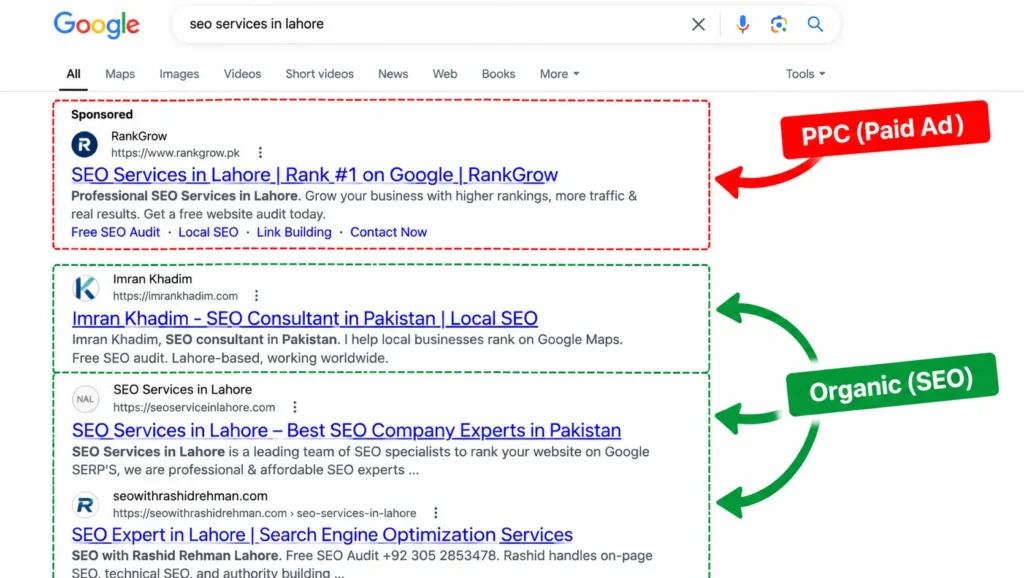
| Position on the page | Below ads, in the map pack and organic results | Top and bottom of results, marked “Sponsored” |
| Control | Google decides rankings and snippets | You control text, budget, timing, location and audience |
| Testing speed | Slow; changes take weeks to show | Fast; test offers and messages in days |
| Trust | Organic listings and reviews often feel more credible | Clearly labelled as ads |
| Keyword data | Search Console shows queries, but not every one | Full search terms report for your ads |
| Risk | Algorithm updates can move rankings | Rising click costs and wasted spend if set up badly |
| Skills needed | Technical, content and link building | Account structure, bidding, copywriting, tracking |
The table shows why the question is less “which is better” and more “which fits where my business is right now”.
How the costs really compare
Both channels cost money. The difference is how that money behaves over time.
What PPC costs in Pakistan
With Google Ads, you set a budget and pay per click. In 2026, Pakistani agencies report clicks from roughly PKR 20 to 150 for e-commerce and local services, and PKR 150 to 800 for real estate, healthcare, education and B2B. On top of ad spend, card payments in foreign currency usually add around 5 to 7 percent in taxes and bank charges, plus a management fee if someone runs the account for you.
My full breakdown of Google Ads cost in Pakistan covers CPCs by industry, budgets and the tax details.
What SEO costs in Pakistan
SEO is usually paid as a monthly retainer to a freelancer, consultant or agency, or done in-house. You pay for audits, technical fixes, content, local profile work and link building. There is no fee to Google for organic clicks, so once a page ranks, each extra visitor costs nothing extra. Typical monthly ranges by provider type are in my guide to SEO cost in Pakistan.
A simple example
Take a dental clinic in Lahore spending PKR 90,000 a month on Google Ads at an average of PKR 150 a click. That buys about 600 clicks a month. In month twelve, the clinic is still paying roughly the same for the same 600 clicks.
Now suppose the clinic spends a similar amount on SEO. In the first months, it may get very few extra visits. If the work succeeds and the clinic reaches the map pack and page one for its main treatments, those visits keep arriving without a click charge. Over two or three years, the cost per visitor from SEO usually falls well below PPC.
The catch is the word “if”. SEO results are not guaranteed, and a poor SEO provider can spend a year’s budget with little to show. PPC results are predictable from the first week.
How quickly each one brings customers
| Timeline | PPC | SEO |
|---|---|---|
| Day 1 to week 2 | Ads live, first clicks and calls | Audit, fixes and planning; little visible change |
| Month 1 to 2 | Data shows which keywords convert; costs start to settle | Google Business Profile and on-page changes start to register |
| Month 3 to 6 | Stable cost per lead if optimised | First real ranking and traffic growth for less competitive terms |
| Month 6 to 12 | Same results for the same spend | Growth compounds as more pages rank |
| Year 2 onward | Same, or higher as competitors bid | Lower cost per visitor if rankings hold |
These are typical patterns, not promises. Competitive keywords in Karachi or Lahore take longer to rank than niche terms in smaller cities.
What happens when you stop spending
This is the biggest practical difference between the two.
- Stop PPC: your ads disappear within minutes and the calls from them stop the same day.
- Stop SEO: rankings usually stay for a while, then slowly slip as competitors keep improving and your content ages.
A business that has spent two years on SEO owns pages that keep working. A business that has spent two years on PPC owns data and experience, but no lasting position in search.
When PPC is the better choice
Choose PPC first when:
- You need leads this month, for example a new clinic, showroom or restaurant opening
- Your website is new and has no chance of ranking quickly
- You run short offers, such as Ramadan deals, Eid collections, admissions or White Friday sales
- You want to test demand for a new service or city before investing in content
- Your keywords are very competitive and organic page one is out of reach for now
- You sell high-value services where one customer covers many clicks, such as property, study abroad or B2B software
When SEO is the better choice
Choose SEO as the main channel when:
- You plan to run the business for years, so long-term cost per visitor matters
- Your customers search locally, such as “dentist near me” or “car rental Islamabad”, where the map pack drives calls
- Your budget is limited, and you cannot keep paying for every click indefinitely
- People research before buying, reading guides, prices and comparisons first
- Click costs in your industry are high and keep rising
- Trust matters, such as healthcare, legal or financial services, where reviews and organic presence carry weight
For local businesses, the Google map pack often brings more calls than paid ads, and it is earned through local SEO rather than bought.
Which to choose by business type
| Business type | Start with | Then add | Why |
|---|---|---|---|
| New clinic or dental practice | PPC for treatments + Google Business Profile | SEO for treatment pages and reviews | Patients search urgently; map visibility takes a few months |
| Established local service | SEO and local SEO | PPC for high-value services or new areas | Map pack and organic pages already produce calls |
| Online store | Shopping ads and PPC on best sellers | SEO for categories and product guides | Ads drive sales now; category rankings build over time |
| Rent-a-car or travel | PPC around Eid and summer peaks | SEO for location and vehicle pages | Seasonal spikes suit ads; pages must rank before peaks |
| Real estate | PPC for project launches | SEO for area guides and listings | Launch dates are fixed; area content ranks long term |
| SaaS or B2B | PPC on high-intent terms | SEO for comparisons, guides and use cases | Long sales cycles reward content that keeps ranking |
| Brand new website, small budget | Small PPC test + SEO basics | Grow SEO as budget allows | Validate keywords cheaply before investing in content |
Clinics have a particular reason to combine both: treatment searches are urgent, but patients still check reviews and the map listing before calling, which is why dental SEO and ads tend to support each other.
Using SEO and PPC together
The strongest results usually come from running both and letting each improve the other.
Use PPC data to choose SEO keywords
The Google Ads search terms report shows exactly which searches led to calls or sales. Those keywords deserve SEO pages, because you already know they convert.
Cover more of the results page
When your ad, your map listing and your organic result all appear for the same search, you take more of the page from competitors and look more established.
Cut ad spend where you already rank
Once a page ranks at the top organically for a keyword, test reducing bids on that keyword and watch whether total clicks and leads hold.
Protect your brand name
Competitors sometimes bid on your business name. A low-cost brand campaign keeps your ad above theirs while your organic listing sits below.
Fix landing pages once, benefit twice
A clear, fast, relevant page improves Google Ads Quality Score, which lowers cost per click, and also helps organic rankings. The same page-level work is covered in my list of on-page SEO factors.
What is different about SEO and PPC in Pakistan
Global SEO vs PPC guides miss several local factors.
- Mobile first, by a wide margin. Most searches happen on phones, often on mobile data. Slow pages waste ad spend and lose organic visitors alike.
- WhatsApp as the main contact. Many Pakistani customers prefer to message rather than call or fill forms. Track WhatsApp clicks as conversions in both channels.
- Roman Urdu and Urdu searches. Searches like “dant ka doctor” or “gari kiraye par” often have fewer advertisers and lower click costs, and are easier to rank for organically.
- Card payment costs. Google Ads paid by card in foreign currency carries extra taxes and bank charges, and exchange rate changes can raise your effective cost. SEO fees are usually paid locally in rupees.
- Strong seasonality. Ramadan, Eid, wedding season and back-to-school months change both ad costs and search demand. Ads respond instantly; SEO pages need to be ready weeks before.
- Big marketplaces in organic results. For many product searches, Daraz and other marketplaces dominate organic listings, which can make Shopping ads the faster route for small stores while e-commerce SEO builds category rankings.
AI search is changing both channels
Google’s AI Overviews now answer many informational searches directly on the results page, which can reduce organic clicks for “what is” and “how to” queries. Ads still appear around them, and commercial searches with clear buying intent still send most clicks to websites.
For SEO, this means being the source that AI tools quote matters more each year. For PPC, it means competition for commercial searches can rise as more businesses chase the clicks that remain. Being cited in AI answers is the focus of AI search optimisation.
Common mistakes when choosing between SEO and PPC
- Judging SEO after six weeks. SEO needs months; stopping early wastes the money already spent.
- Running ads to the homepage. A focused landing page for each service converts far better and lowers click costs.
- Running PPC without conversion tracking. Without it, you cannot tell which keywords bring customers.
- Buying cheap SEO to save money. Low-cost link packages can cause penalties that take longer to fix than doing nothing. My guide to common SEO hiring mistakes lists the warning signs.
- Treating it as either/or forever. The right mix changes as rankings grow and budgets shift.
Five questions to decide your mix
Answer these honestly before choosing:
- How soon do you need customers? If within a month, start with PPC.
- How long will you run this business or service? If years, invest in SEO now.
- What is one customer worth to you? If high, paid clicks are easier to justify.
- Do customers search locally? If yes, local SEO should be part of the plan from day one.
- Can your website convert visitors? If not, fix the site first; neither channel works well with a weak site.
If you are unsure what your site can achieve organically, a free SEO audit shows how far you are from ranking and whether SEO is worth the investment for your business right now.
Frequently asked questions
Is SEO better than PPC?
Neither is better in every case. PPC is better for fast results, short campaigns and testing. SEO is better for long-term visibility and lower cost per visitor over time. Most businesses get the best return by using both at different stages.
Is PPC more expensive than SEO?
In the short term, SEO can feel more expensive because results take months. Over the long term, PPC usually costs more per visitor, because every click is paid for and click prices tend to rise with competition.
Can I do SEO and PPC at the same time?
Yes, and it often works best. PPC brings leads while SEO builds, ad data shows which keywords to target organically, and appearing in both ads and organic results increases visibility for the same searches.
Does running Google Ads improve SEO rankings?
No. Google states that advertising does not affect organic rankings. PPC can help SEO indirectly by showing which keywords convert and by increasing brand searches, but it does not change where your pages rank.
How long does SEO take compared with PPC?
PPC can bring visitors within hours of ad approval. SEO usually takes three to six months to show meaningful results, longer for competitive keywords, while local map rankings can improve sooner.
What is the minimum budget for PPC in Pakistan?
Google has no minimum spend. In practice, around PKR 30,000 a month is a sensible starting test for most small businesses, because smaller budgets rarely buy enough clicks to learn which keywords work.
Should a new business start with SEO or PPC?
Most new businesses should start with PPC for immediate enquiries and set up SEO foundations at the same time, such as Google Business Profile, service pages and tracking, so organic visibility grows while ads run.