

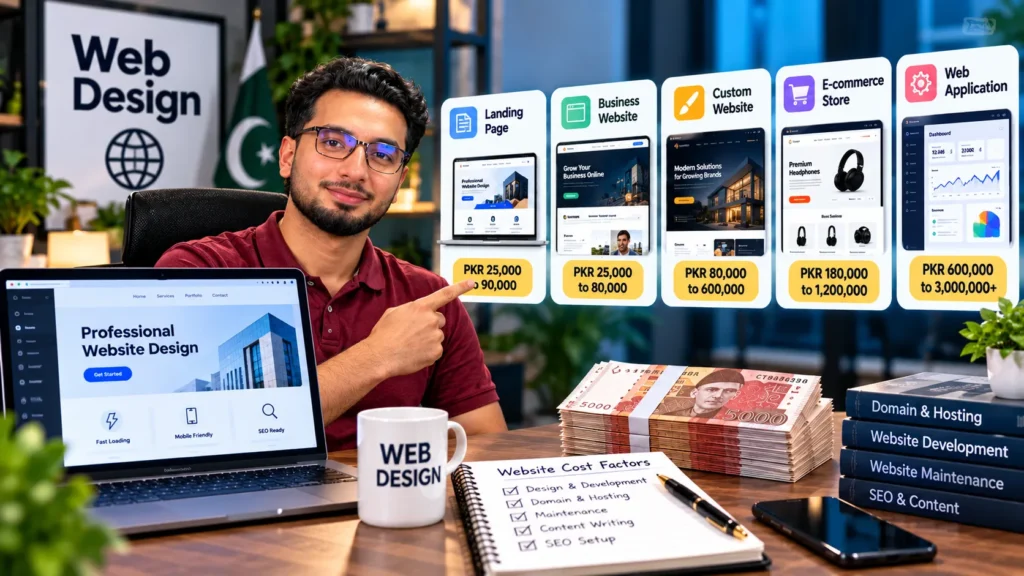
A website in Pakistan costs between PKR 25,000 and PKR 3,000,000 or more in 2026, depending on what it needs to do. A simple template site of five to eight pages usually costs PKR 25,000 to 80,000. A custom-designed business website costs PKR 80,000 to 600,000. An online store costs PKR 180,000 to 1,200,000, and a custom web application starts around PKR 600,000. Domain, hosting and maintenance add roughly PKR 15,000 to 150,000 a year on top.
Website prices in Pakistan at a glance
The ranges below combine prices published in 2026 by Pakistani web agencies and software houses. Use them to check whether a quote is in a sensible range, not as a fixed price list.

| Type of website | Typical size | Build cost (PKR) | Usual timeline |
|---|---|---|---|
| Landing page | 1 page | 25,000 to 90,000 | 1 to 2 weeks |
| Template business website | 5 to 8 pages | 25,000 to 80,000 | About 2 weeks |
| Designed business website | 5 to 15 pages | 80,000 to 600,000 | 4 to 8 weeks |
| E-commerce store | Catalogue, cart, checkout | 180,000 to 1,200,000 | 8 to 14 weeks |
| Custom web application or portal | Logins, dashboards, custom logic | 600,000 to 3,000,000+ | 3 months and longer |
Why the ranges are so wide:
- Who builds it. A student freelancer and a software house with designers, developers and testers price the same page very differently.
- Design depth. Installing a ready-made theme takes days. Designing every page from scratch in Figma takes weeks.
- What is included. Some quotes include content writing, photos, SEO setup and a year of support. Others include only the build.
What you get at each price level
The price tells you more when you know what work sits behind it. These are the five common website types in Pakistan and what each one usually includes.
Landing page
A landing page is a single page built for one offer, such as a course admission, a property launch or a Google Ads campaign. It usually has a headline, benefits, proof, a form and a WhatsApp or call button.
Landing pages are cheap to build but only work if the copy is strong and the page loads fast on mobile data. If you are planning paid ads, the page matters as much as the budget; my guide on Google Ads cost in Pakistan explains why sending ad clicks to a weak page wastes money.
Template business website
This is the most common first website for shops, clinics, consultants and service businesses. A designer installs a WordPress theme, changes colours and fonts, adds your logo and fills five to eight pages: home, about, services, contact and perhaps a gallery or blog.
- Good for: getting online quickly on a small budget
- Usual limits: generic look, slow page builders, little or no content writing, basic SEO settings only
- Watch for: pirated or “nulled” themes, which can carry malware and never receive security updates
Designed business website
At this level, a designer creates the layout for your business first, then a developer builds it. You get custom page designs, stronger copy, proper service pages, faster loading and better tracking.
This is the right level for businesses that rely on the website to bring enquiries, such as clinics, law firms, construction companies and B2B suppliers. Prices at the top of this band usually include content writing, photography direction and a few rounds of revisions.
E-commerce store
An online store needs a product catalogue, cart, checkout, payment and delivery setup, and order management. In Pakistan, it also needs cash on delivery, local payment options such as JazzCash, Easypaisa or a bank payment gateway, and courier integration with companies such as TCS, Leopards or PostEx.
Costs rise with the number of products, filters, variants, languages and integrations. A store with 50 products and one courier is a different job from a store with 5,000 products, a stock system and three couriers.
Custom web application
Booking systems, student portals, marketplaces, CRMs and SaaS products fall here. They are built with frameworks such as Laravel, React, Next.js or Node.js rather than a ready-made platform. You pay for planning, interface design, development, testing and hosting setup, and you will need a developer on call after launch.
Website cost by platform
The platform affects the build price, the yearly running cost and how easy the site is to change later.

| Platform | Typical use in Pakistan | Build cost | Running cost | Things to know |
|---|---|---|---|---|
| WordPress | Business sites, blogs, service companies | Low to medium | Hosting plus any premium theme or plugin licences | Most widely used; easy to edit; needs updates and security care |
| WooCommerce (WordPress) | Small and mid-size online stores | Medium | Hosting plus paid extensions | Full control, works with local gateways and couriers through plugins |
| Shopify | Fashion, beauty and product brands | Low to medium | Monthly plan fee in US dollars plus paid apps | Hosting included; Shopify Payments is not offered in Pakistan, so a third-party gateway and its fees apply |
| Wix or Squarespace | Portfolios and very small sites | Very low | Monthly or yearly subscription | Quick to set up, less flexible for SEO and growth |
| Custom code (Laravel, React, Next.js) | Web apps, portals, complex sites | High | Server and developer support | Built to your exact needs; you depend on developers for most changes |
If you choose WordPress, ask the developer how they will keep the site fast, because heavy page builders and too many plugins are the most common reason Pakistani business sites load slowly. The same issues affect rankings, which is what WordPress SEO work fixes.
Freelancer, agency or software house: who charges what
Who builds the site changes the price more than any other factor. Each option suits a different kind of project.
| Provider | Typical hourly rate (PKR) | Best for | Main risk |
|---|---|---|---|
| Freelancer | 500 to 1,500 | Template sites, landing pages, small fixes | Availability and support after launch |
| Small agency | 1,500 to 3,500 | Designed business websites, small stores | Junior staff doing most of the work |
| Software house | 3,000 to 8,000 | Large stores, web apps, integrations | Higher cost and slower changes |
On Upwork, Pakistan-based WordPress developers commonly list rates of about $3 to $11 an hour (roughly PKR 850 to 3,100), which matches the local freelancer band.
A lower hourly rate does not always mean a lower total. An experienced developer may finish in 20 hours what a beginner takes 60 hours to do, and with fewer problems after launch.
Yearly costs after the website goes live
Most website quotes in Pakistan cover only the build. These costs come every year and belong in your budget from day one.

| Running cost | Typical yearly cost (PKR) | Notes |
|---|---|---|
| Domain (.com) | 2,500 to 6,000 | Price depends on the registrar and renewal rate |
| Domain (.pk or .com.pk) | About 1,800 to 2,100 at PKNIC base rate | Billed in two-year blocks; resellers add their own margin |
| Shared hosting | 5,000 to 25,000 | Fine for most small business sites |
| VPS or cloud hosting | 20,000 to 300,000 | For busy stores, web apps and high-traffic sites |
| SSL certificate | Often free | Most hosts include a free certificate |
| Premium theme or plugin renewals | Varies | Many licences renew yearly for updates and support |
| Business email | Per user, per month | Google Workspace or Microsoft 365 if you need branded email |
| Maintenance and support | 30,000 to 150,000 | Updates, backups, security checks and small edits |
Domain
Always register the domain in your own name and keep the login. If a designer registers it under their account and later disappears, getting it back can take weeks. PKNIC manages .pk domains and raised its base fee in 2026, so check the current rate before you budget.
Hosting
Cheap shared hosting is enough for a five-page site with modest traffic. An online store running sales campaigns or a site with heavy images needs better hosting, or it will slow down exactly when visitors arrive. Ask where the server is located, how backups work and who to contact when the site goes down.
Maintenance
WordPress core, themes and plugins need regular updates. Skipping them is the most common way small Pakistani business sites get hacked. A maintenance plan should cover updates, daily or weekly backups, uptime checks and a set number of edits each month.
A worked example: first-year cost of a clinic website
Numbers become clearer with a real budget. Here is an illustrative first-year cost for a seven-page WordPress website for a dental clinic in Lahore, built by a small agency.
| Item | Cost (PKR) |
|---|---|
| Design and build, 7 pages | 120,000 |
| Premium theme licence | 15,000 |
| Content writing, 7 pages | 20,000 |
| Professional photos of clinic and team | 15,000 |
| .com domain, 1 year | 4,000 |
| Shared hosting, 1 year | 12,000 |
| Maintenance, PKR 3,000 a month | 36,000 |
| First-year total | 222,000 |
The build is only a little over half of the first-year cost. For clinics, the website also needs treatment pages and trust details that patients look for, which dental SEO builds on after launch. In year two, the clinic pays mainly for domain, hosting and maintenance, about PKR 52,000, unless it adds new pages or features.
What pushes a website quote up
When two designers quote very different prices for “the same website”, the difference usually comes from one of these.
- Custom design instead of a theme. Each page designed from scratch adds design and development hours.
- Number of templates, not pages. Ten service pages that share one layout cost less than ten pages with ten different layouts.
- Integrations. Payment gateways, couriers, booking calendars, CRMs and WhatsApp chat each add work and testing.
- Content. Writing copy, translating into Urdu and preparing product descriptions take real time.
- Languages. An English and Urdu site needs right-to-left layout support and double the content.
- Speed and mobile work. Building a site that loads fast on a mid-range Android phone over mobile data takes extra effort, and it is the focus of mobile SEO.
- Revision rounds. Unlimited revisions are rarely unlimited. More agreed rounds mean a higher price.
- Support after launch. A quote that includes three to twelve months of support costs more than a handover with no support.
What cheap quotes usually leave out
A PKR 20,000 website can look like a bargain until you need something that was never included. Before accepting a very low quote, check for these gaps:
- Content writing. You may be expected to write every page yourself.
- Images. Stock photos may be unlicensed, which can lead to copyright claims.
- Theme licence. A nulled theme saves the designer money and puts your site at risk.
- Domain ownership. The domain may be registered in the designer’s name.
- Admin access. Some designers keep the only admin login.
- Backups. No backup means one hack or bad update can wipe the site.
- SEO setup. No page titles, no sitemap, no Search Console connection.
- Post-launch support. Small changes after handover are charged separately or ignored.
SEO work that should happen during the build
Fixing SEO problems after launch costs more than building them in from the start. Ask your designer whether these are included, and get them in writing.
- Page structure. One page per main service, with a clear title and heading on each.
- Technical basics. A clean URL structure, XML sitemap, correct robots.txt, HTTPS and no broken links. If the site is replacing an old one, every old URL needs a 301 redirect, or rankings can drop overnight. This is part of technical SEO.
- Speed and Core Web Vitals. Compressed images, light themes and caching. Most visitors in Pakistan arrive on mobile, so mobile checks matter before launch, not after.
- On-page settings. Unique page titles, meta descriptions, image alt text and internal links between related pages. These are the basics of on-page SEO.
- Local business details. For businesses serving one city, the same name, address and phone number on the website as on your Google Business Profile, plus a map and LocalBusiness schema. This supports local SEO from day one.
- Tracking. Google Analytics 4, Google Search Console and tracking for calls, WhatsApp clicks and form submissions.
For online stores, category structure, product page templates and filter settings decide how well the store can rank later. Plan them with e-commerce SEO in mind before the developer starts building.
A website build covers the setup. Ongoing SEO after launch is a separate monthly cost; my guide to SEO cost in Pakistan covers what that usually looks like.
How to read a website quote
A good quote lets you see exactly what you are paying for. Check each of these before you pay an advance.
- Page list. Every page named, not just “up to 10 pages”.
- Design approach. Custom design or a theme, and which theme if so.
- Features and integrations. Payment gateway, courier, booking, forms, WhatsApp, each listed.
- Content and images. Who writes, who supplies photos, and whether licensed stock is used.
- Revisions. How many rounds are included at design stage and at build stage.
- Ownership. Domain, hosting, theme licence and admin access in your name.
- Payment schedule. For example, 50 percent advance, 30 percent on design approval and 20 percent on launch.
- Support period. What is covered after launch, for how long, and the monthly cost afterwards.
- Timeline. Start date, design sign-off date and launch date, including what happens if your content is late.
How to spend less without getting a worse website
Saving money on a website is possible if you cut the right things.
- Start with fewer pages. Launch with the pages that bring enquiries and add the rest later.
- Prepare content yourself. Write rough drafts of your services and prices so the designer edits rather than writes from nothing.
- Use one design template for similar pages. Service pages and location pages can share a layout.
- Buy a licensed theme. A good premium theme costs less than custom design and gets security updates.
- Pay for hosting yourself. Buying hosting directly avoids reseller mark-ups and keeps control with you.
- Phase the features. Launch the store with cash on delivery first, then add card payments once orders grow.
Frequently asked questions
How much does a basic website cost in Pakistan?
A basic template website of five to eight pages usually costs PKR 25,000 to 80,000 when built by a freelancer or small agency. This normally covers design changes to a ready-made theme, basic pages and a contact form, but often not content writing or ongoing support.
How much does an e-commerce website cost in Pakistan?
Online stores usually cost PKR 180,000 to 1,200,000 to build. The price depends on the number of products, payment gateways, courier integrations and custom features. Platform fees, apps and hosting are paid separately every month or year.
What is the cost of domain and hosting in Pakistan?
A .com domain usually costs PKR 2,500 to 6,000 a year, and a .pk domain about PKR 1,800 to 2,100 a year at PKNIC’s base rate, billed two years at a time. Shared hosting for a small business site usually costs PKR 5,000 to 25,000 a year.
Is WordPress cheaper than Shopify in Pakistan?
WordPress is usually cheaper to run for business websites, because you pay only for hosting and any premium licences. Shopify can be cheaper to set up for a product store, but it charges a monthly plan fee in US dollars, plus app fees and gateway charges.
How long does it take to build a website in Pakistan?
A template business website usually takes about two weeks. A custom-designed site takes four to eight weeks, and an online store eight to fourteen weeks. Delays in providing content and approvals are the most common reason projects run late.
How much does website maintenance cost in Pakistan?
Maintenance usually costs PKR 30,000 to 150,000 a year, depending on how often the site is updated and how much support is included. It should cover software updates, backups, security checks and small content changes.
Should I hire a freelancer or an agency for my website?
A freelancer suits small template sites and tight budgets. An agency or software house suits custom designs, online stores and projects that need several skills at once. In both cases, check past work, confirm who owns the domain and logins, and agree on support after launch.