
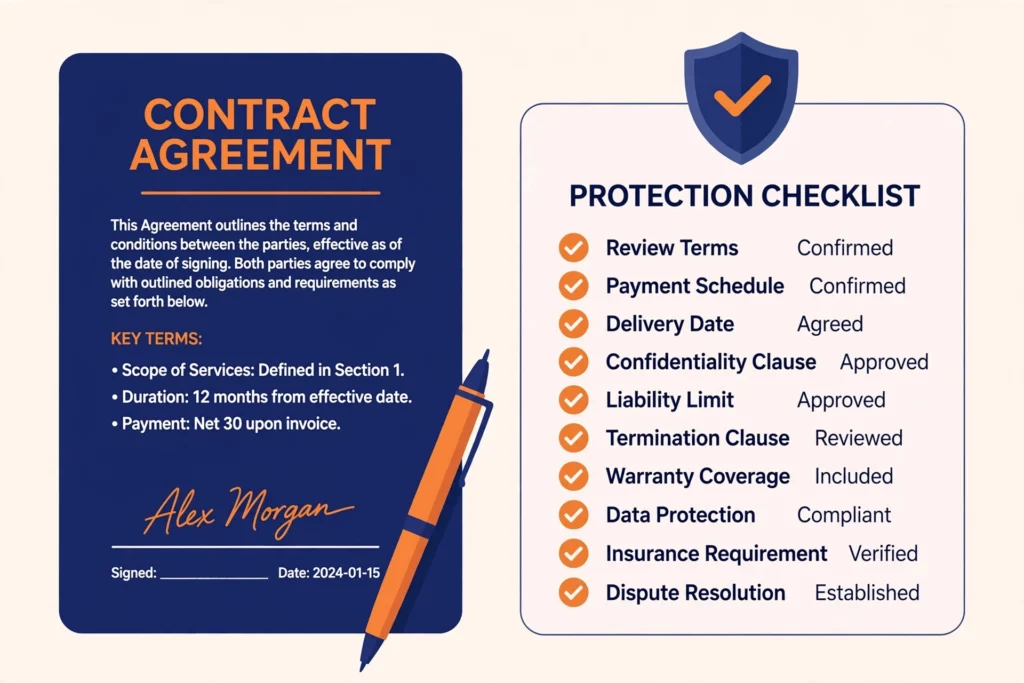
Most SEO disputes I hear about in Pakistan have the same root cause: there was no real contract. There was a WhatsApp chat, a verbal promise, and a monthly bank transfer. Then the rankings did not move, the “expert” stopped answering, and there was nothing to point to.
A contract protects both sides. It tells you exactly what you are buying, and it tells the provider exactly what they must deliver. If a provider resists putting things in writing, that resistance is your answer.
Here are the ten clauses every SEO contract in Pakistan should contain, whether you are hiring a freelancer or an agency.
1. Exact scope of work
The contract must state precisely which SEO services are covered: technical SEO, on-page optimisation, content creation, link building, local SEO, or a defined combination. “Complete SEO services” is not a scope – it is a blank cheque for disagreement later.
Good scope language names the website (domain), the target market (Lahore, Pakistan-wide, international), and the service boundaries. If you are hiring for local SEO, the scope should say so explicitly, so nobody later claims “content writing was never included.”
2. Named deliverables with quantities and frequency
This is the clause that separates professionals from storytellers. Every deliverable should be named with a number and a rhythm:
- “Technical SEO audit in month one, with a prioritised fix list”
- “4 optimised blog articles per month, minimum 1,000 words each”
- “Keyword research covering up to 100 target keywords per quarter”
- “Monthly performance report in PDF plus a 30-minute review call”
Volume caps matter too – they prevent scope creep in both directions. And each deliverable should have an owner: who writes, who approves, who publishes.
3. Exclusions – what is NOT included
Honest contracts say what they will not do. Common exclusions worth stating: social media management, paid advertising, website development work beyond SEO recommendations, and content approval delays caused by the client.
The most important exclusion to see in writing: paid links, link schemes, and guaranteed rankings. If a contract promises “100 backlinks per month” without saying how they are earned, you are looking at a future penalty, not a strategy.
4. KPIs and how they are measured
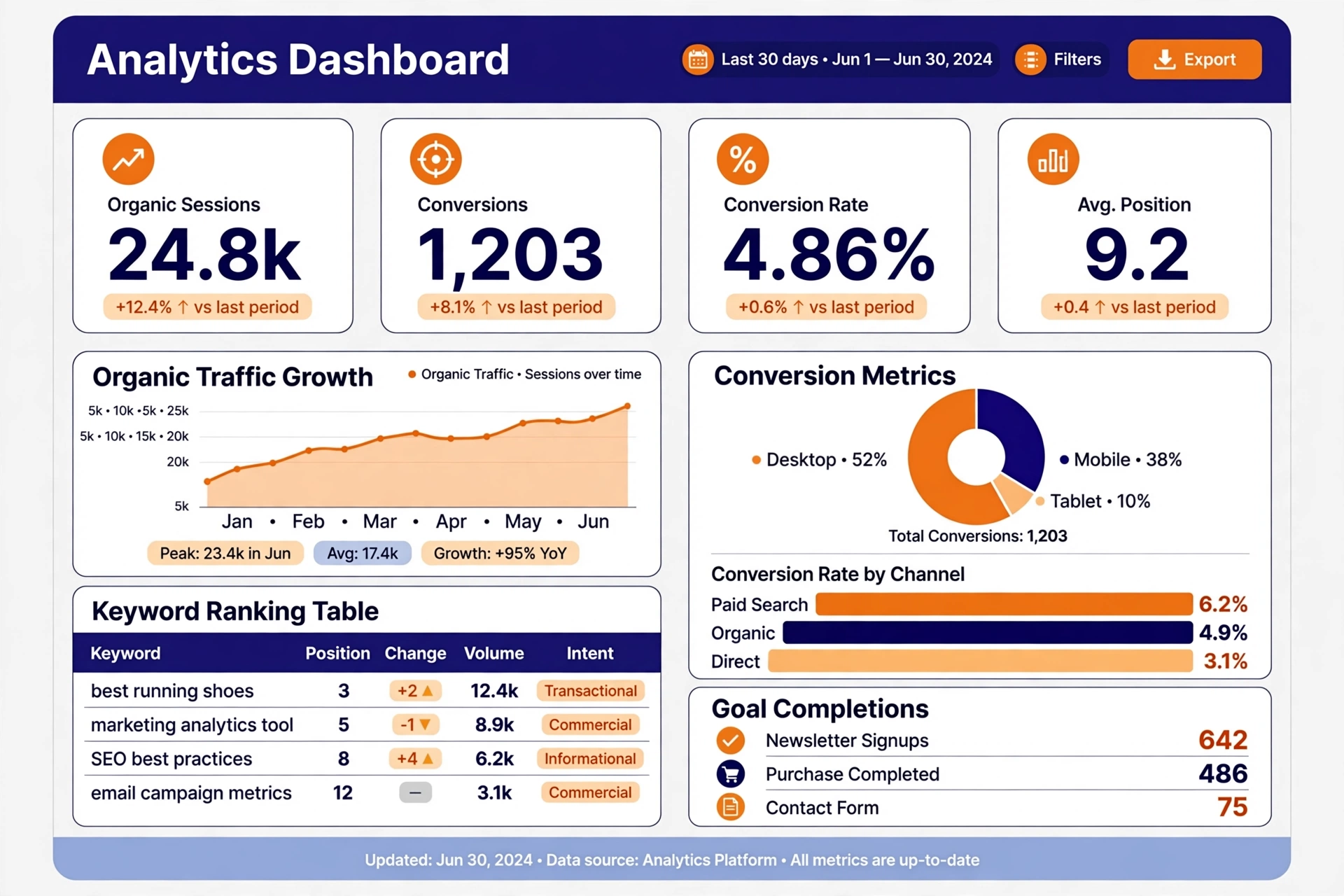
“Success” must be defined before money changes hands, using metrics both sides can verify independently:
- Organic traffic growth (measured in Google Analytics 4)
- Keyword ranking movements for an agreed target list (measured in Google Search Console, Ahrefs, or Semrush)
- Conversion rate or enquiry growth from organic traffic (measured in GA4 or your CRM)
- Technical health: crawl errors resolved, Core Web Vitals improvements
Set baselines at signing and review targets at 30, 60, and 90 days. One warning: rankings alone are a vanity metric. A contract that only promises positions, without traffic or enquiry targets, is optimised for screenshots, not for your business.
5. Timelines and milestones
SEO is slow – anyone honest will tell you three to six months for meaningful movement. The contract should reflect that reality with phased milestones:
- Month 1: audit, keyword research, technical fixes begin
- Months 2-3: on-page optimisation, content publishing starts
- Months 4-6: authority building, performance review against targets
Milestones protect you from the two classic failures: the provider who does nothing for five months and then blames “Google’s algorithm,” and the client who expects page one in week three.
6. Reporting format and frequency
The contract should specify: monthly reports, what is in them, and where the data comes from. Insist on:
- Reports tied to YOUR Google Analytics 4 and Search Console – not just their screenshots
- Work log: what was actually done that month (hours mean nothing; actions mean everything)
- Plain-language summary, not just exported charts
A provider who will not give you direct access to the data is a provider you cannot verify. That is not a partnership; it is a subscription to trust.
7. Payment terms
Spell out the amount, the billing cycle, the payment method, and when payment is due. In Pakistan, common structures are monthly advance bank transfer or per-project milestone payments.
Three rules I recommend:
- Never pay the full project fee upfront. A deposit of 30-50% with the balance on milestones is standard and fair.
- Tie retainer payments to deliverable completion, not to calendar dates alone. “PKR 100,000 per month for the agreed deliverables” beats “PKR 100,000 per month.”
- Get every payment term in the written contract. A rate agreed on a phone call and a rate in the contract are two different rates when there is a dispute.
8. Termination rights
This clause tells you how either side can walk away, and it is where confident providers distinguish themselves:
- Notice period: 30 days is standard and fair to both sides.
- No long lock-ins: refuse 6- or 12-month binding terms before results exist. Month-to-month after an initial 3-month commitment is the honest structure – it gives SEO enough time to show direction while keeping the provider accountable.
- Handover: on termination, you should receive all logins, reports, content files, and documentation of work done. State this explicitly – disorganised handover is how providers hold clients hostage.
9. Confidentiality and access
The provider will need access to your website, Analytics, Search Console, and possibly your Google Business Profile. The contract should cover:
- What access is granted and to whom
- That your business data stays confidential
- That access credentials are returned or revoked on termination
- Who owns the content created during the engagement (answer: you should – state it)
For agencies, add a line: you have the right to know the names and seniority of the people working on your account. Quiet outsourcing to juniors is an industry-wide problem; sunlight is the fix.
10. No guaranteed rankings – and a white-hat commitment
Google controls rankings. Nobody else does. Any contract containing “guaranteed #1 ranking” or “guaranteed first page in X days” is a contract with a liar – or with someone planning to buy the ranking temporarily with spam that will eventually burn your domain.
The clause you want instead: a commitment that all work follows Google’s spam policies – no link schemes, no cloaking, no hacked links, no fake reviews. This is your legal shield if a provider’s shortcuts ever get your site penalised.
Pakistan-specific notes
A few things I have learned about contracts in this market:
- WhatsApp promises do not count. If it is not in the signed document, it does not exist. Screenshot the chat if you must, but get it into the contract.
- Stamp paper is not required for a service agreement to be meaningful, but a signed PDF with both parties’ CNIC/names, scope, and payment terms is enormously better than nothing. For larger engagements, a lawyer-drafted agreement is worth the small fee.
- PSEB-registered agencies (Pakistan Software Export Board) have a verifiable government credential – worth checking for agency hires, though it is no substitute for the clauses above.
- Advance payment culture is normal, but advance plus no contract is just a donation. Always pair them.
Five contract red flags – refuse and walk away
- Vague deliverables. “We will improve your SEO” ships nothing measurable.
- Guaranteed rankings or timelines. Page one in 30 days is a lie told to close you.
- No termination clause. If you cannot leave, you are not a client – you are revenue.
- They keep all logins and files. Your website, your data, your content. Full stop.
- Payment demanded only in cash with no receipt. Untraceable money plus no contract equals no recourse.
What if they won’t sign a proper contract?
Then do not hire them. I say this as someone who sells SEO for a living: a provider who will not commit to scope, deliverables, and termination terms in writing is telling you exactly how the engagement will go. The good ones sign gladly – the contract protects them too.
If you want to see what working with me looks like before any contract exists, start with my free SEO audit. It shows you how I think, what I find, and whether we are a fit – with zero commitment on either side. And if you are comparing options, my guide to SEO costs in Pakistan will help you judge whether a quote is fair before you sign anything.
Frequently asked questions
Do I really need a written SEO contract in Pakistan?
Yes. Most SEO disputes here come from verbal or WhatsApp-only agreements. A signed document with scope, deliverables, payment terms, and termination rights protects both sides and costs nothing to create.
What is a fair contract length for SEO services?
An initial 3-month commitment with month-to-month after that is the honest structure. It gives SEO time to show direction while keeping the provider accountable. Refuse 6- or 12-month lock-ins signed before any results exist.
Should the contract guarantee rankings?
No – and you should refuse any contract that does. Nobody controls Google’s rankings. The contract should instead commit to white-hat methods and define success through verifiable KPIs like organic traffic and enquiries.
Who owns the content created during the SEO engagement?
You should. State explicitly in the contract that all articles, reports, keyword research, and optimisations belong to you and will be handed over on termination, whatever the reason for ending the engagement.
What payment structure is safest?
A 30-50% deposit with the balance tied to milestones for project work; monthly payments tied to named deliverables for retainers. Never pay 100% upfront, and always get payment terms in the written contract – not just in a chat.
Related reading: SEO Expert vs SEO Agency in Pakistan – which type of provider the contract will be with; SEO Cost in Pakistan 2026 – what fair pricing looks like before you sign.