
To get cited by ChatGPT and Google AI Overviews, a small business needs three things. First, pages that Google and Bing can crawl and index, with search bots such as Googlebot, Bingbot and OAI-SearchBot allowed in robots.txt. Second, content that holds information other sites do not have, such as your own prices, local data and real results. Third, mentions of your brand on other trusted websites, which in Ahrefs’ study of 75,000 brands correlated with AI Overview visibility more strongly than backlinks did. Google says AI search optimization “is still SEO”, so files like llms.txt and special schema are not needed.
What “getting cited” means on each AI platform
A citation is a link or source card that an AI answer shows next to its text. Each platform finds its sources in a different way, so one tactic does not fit all of them.
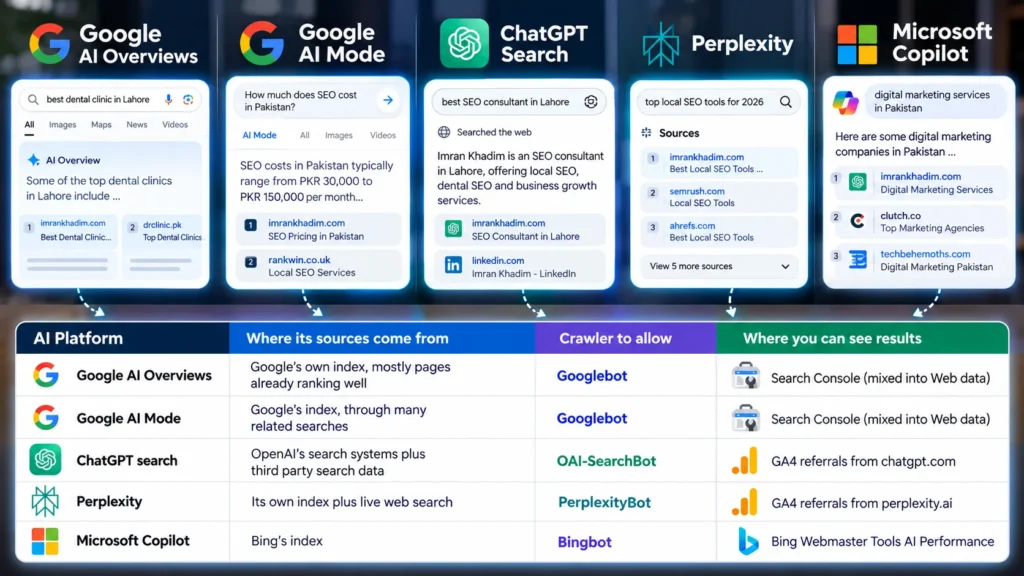
| AI platform | Where its sources come from | Crawler to allow | Where you can see results |
|---|---|---|---|
| Google AI Overviews | Google’s own index, mostly pages already ranking well | Googlebot | Search Console (mixed into Web data) |
| Google AI Mode | Google’s index, through many related searches | Googlebot | Search Console (mixed into Web data) |
| ChatGPT search | OpenAI’s search systems plus third party search data | OAI-SearchBot | GA4 referrals from chatgpt.com |
| Perplexity | Its own index plus live web search | PerplexityBot | GA4 referrals from perplexity.ai |
| Microsoft Copilot | Bing’s index | Bingbot | Bing Webmaster Tools AI Performance |
Google calls the multi search method “query fan-out”. AI Mode splits one question into many smaller searches across subtopics, then builds one answer from the results. That is why a page can be cited for a question it never ranked for directly.
AI Mode has been live in Pakistan in English since August 2025. If your customers are in Lahore, Karachi or Islamabad, some of them are already asking Google longer questions and getting a written answer instead of ten blue links.
Why small businesses should care, and why panic is the wrong response
Pew Research Center tracked 900 US adults and 68,879 Google searches in March 2025. When an AI summary appeared, users clicked a normal result on 8% of visits. Without a summary, they clicked on 15%. Only 1% of visits included a click on a link inside the summary itself.
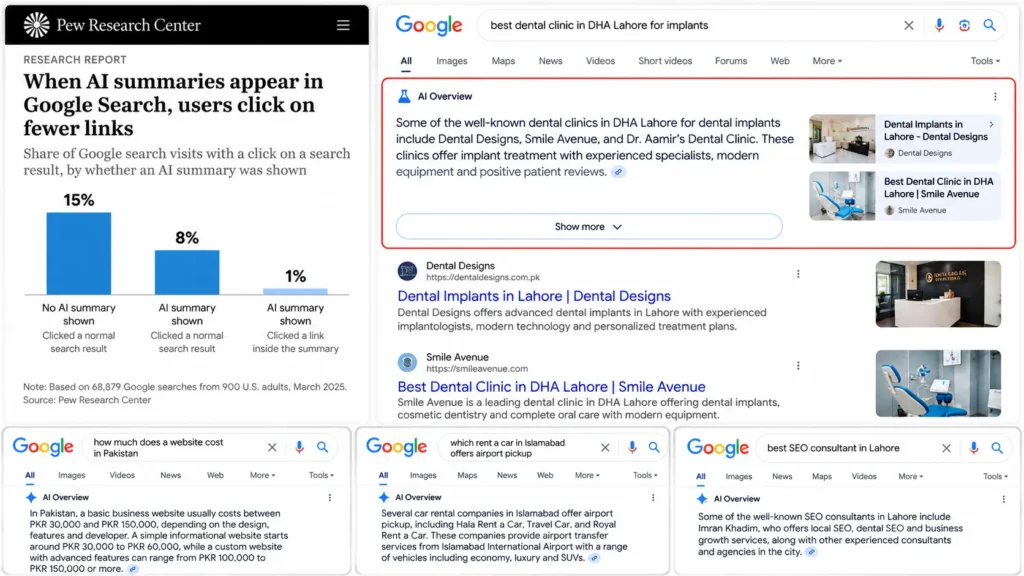
So clicks from informational searches are falling. That part is real.
But the same data shows something small businesses often miss. The people still clicking are further along in their decision. A user who reads an AI answer that names your clinic, then clicks through, often arrives ready to book.
For a small business, the goal is not to win every AI answer. It is to be named in the answers your buyers read just before they choose a supplier:
- “Best dental clinic in DHA Lahore for implants”
- “How much does a website cost in Pakistan”
- “Which rent a car in Islamabad offers airport pickup”
Those are a few dozen questions, not thousands. That makes the job manageable on a small budget.
How AI systems decide which pages to cite
Nobody outside Google or OpenAI knows the exact rules. But three pieces of public research give a clear picture.
Google AI Overviews lean heavily on pages that already rank
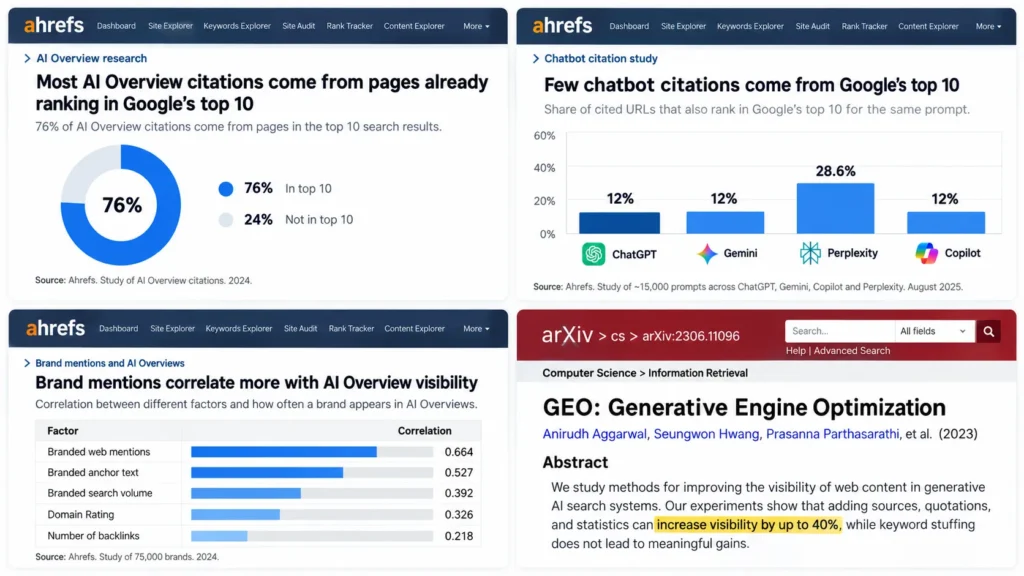
Ahrefs found that about 76% of AI Overview citations come from pages in Google’s top 10 for that query. If your page is on page three, an AI Overview is unlikely to cite it. Normal ranking work comes first.
Chatbots look much further than page one
A separate Ahrefs study of about 15,000 prompts, published in August 2025, found that only 12% of URLs cited by ChatGPT, Gemini and Copilot ranked in Google’s top 10 for the same prompt. Perplexity was higher at 28.6%. Chatbots run their own searches with different wording, so a niche page with a clear answer can be cited even without strong Google rankings.
Brand mentions matter more than links
In Ahrefs’ study of 75,000 brands, these factors correlated with how often a brand appeared in AI Overviews:
| Factor | Correlation |
|---|---|
| Branded web mentions | 0.664 |
| Branded anchor text | 0.527 |
| Branded search volume | 0.392 |
| Domain Rating | 0.326 |
| Number of backlinks | 0.218 |
Correlation is not proof of cause, and Ahrefs says so. Still, the pattern makes sense. A language model learns which brands belong to a topic by seeing them named together across many pages. A brand that only exists on its own website is hard for a model to trust. Paid trackers can count your mentions over time; my list of SEO tools for SaaS startups compares the options.
Specific facts get picked up
The 2023 research paper “GEO: Generative Engine Optimization” by Aggarwal and colleagues tested ways to change how often a source appears in AI answers. The authors report visibility gains of up to 40%. Adding sources, quotations and statistics performed well, while stuffing keywords did not help. The lesson for a business owner: a page that states “implants from PKR 120,000, done in two visits” gives an AI something to quote. A page that says “affordable, high quality care” does not.
What Google says you can skip
In May 2026, Google published “Optimizing your website for generative AI features on Google Search”. It defines AEO and GEO, then says optimizing for generative AI search “is still SEO”. It also lists tactics you do not need.
| Popular advice | What Google says |
|---|---|
| Add an llms.txt file | Not needed for AI features in Google Search |
| Break content into small chunks for AI | Not needed; its systems understand several topics on one page |
| Rewrite pages for every long tail variation | Not needed; AI understands synonyms and meaning |
| Add special AI schema | No special schema is required; normal structured data still helps rich results |
| Buy or chase mentions | Inauthentic mentions are “not as helpful as it might seem” |
Google’s only firm requirement for AI Overviews and AI Mode is that a page is indexed and eligible to show with a snippet. Anyone selling a “secret AI file” for Google is selling something Google has told you to skip.
Other platforms may treat llms.txt differently, and Chrome’s Lighthouse now has an experimental check for it. It costs little to add one. Just do not expect it to change your Google AI visibility.
A seven step AI search plan for a small business
This plan assumes one person, a few hours a week, and no expensive tracking software.
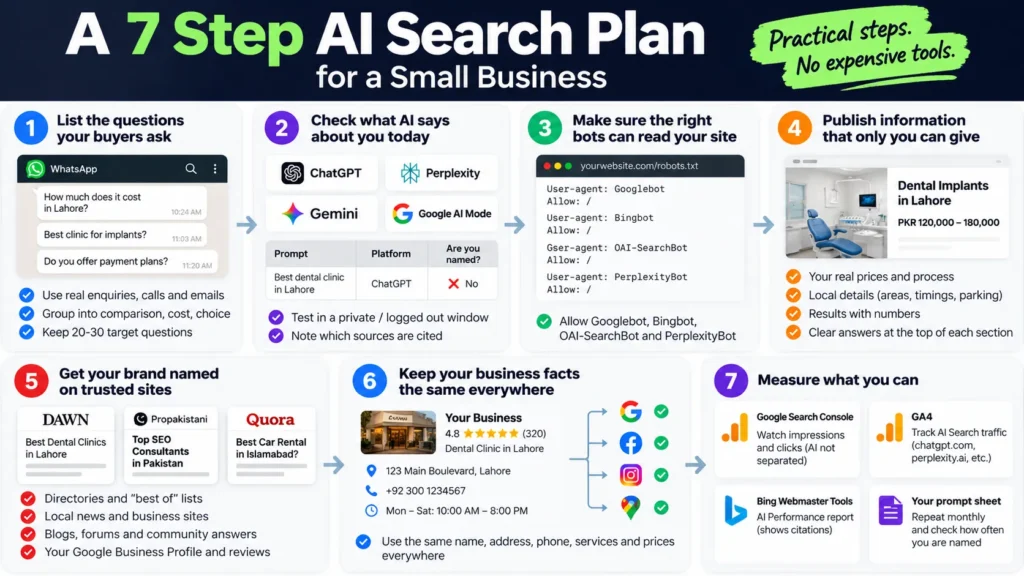
Step 1: List the questions your buyers ask before they choose you
Start from real conversations, not keyword tools. Go through your last 50 WhatsApp enquiries, sales calls and emails. Write down the questions people asked before they paid.
Group them into three types:
- Comparison: “X or Y for a small shop?”
- Cost: “How much does X cost in Lahore?”
- Choice: “Best X near me for Y?”
Twenty to thirty questions is enough. These are your target prompts.
Step 2: Check what AI says about you today
Ask each target prompt in ChatGPT, Perplexity, Gemini and Google AI Mode. Use a logged out or private window so your history does not shape the answer.
Record the results in a simple sheet:
| Prompt | Platform | Are you named? | Who is named instead? | Which sources are cited? |
|---|---|---|---|---|
| Best dental clinic for implants in Lahore | ChatGPT | No | Clinic A, Clinic B | A directory, a news article |
The last column is the most useful. It shows you which websites the AI trusts for your topic. Those are the places you need to appear.
Answers change between runs, so test each prompt two or three times before drawing a conclusion.
Step 3: Make sure the right bots can read your site
AI platforms cannot cite pages they cannot reach. Check your robots.txt file for these search crawlers:
- Googlebot: needed for AI Overviews and AI Mode.
- Bingbot: needed for Copilot, and Bing data also feeds other assistants.
- OAI-SearchBot: needed for ChatGPT search. OpenAI says robots.txt changes take about 24 hours to apply.
- PerplexityBot: needed for Perplexity.
Training bots are a separate choice. Blocking GPTBot stops OpenAI using your content for model training, but it does not remove you from ChatGPT search. Blocking Google-Extended limits Gemini training and grounding, but it does not affect AI Overviews.
Also check your hosting and CDN settings. Some firewall and bot protection settings block AI crawlers without you noticing.
If pages are missing from Google entirely, fix that first. My guide on why a website is not showing on Google covers the usual causes.
Step 4: Publish information that only you can give
Google’s guide uses the term “non-commodity content”. In plain words: do not publish the same general advice that 500 other pages already have. AI does not need your page to explain what a dental implant is.
What AI cannot find elsewhere:
- Your real prices, with a range and what changes the price.
- Your process, with real timelines, such as “first visit, then 3 months healing, then the crown”.
- Local detail, such as which areas you serve, parking, timings and payment methods.
- Results with numbers, such as before and after figures from real projects.
- Opinions with reasons, such as when you would tell a client not to buy your service.
Put the direct answer near the top of each section, then the detail. A section that answers its own heading in the first two sentences is easy for any system to quote. These on-page SEO factors still apply to every page you write.
Step 5: Get your brand named on the sites AI already trusts
Go back to the “sources cited” column from Step 2. Usually you will see the same types of sites again and again:
- Industry directories and “best of” lists
- Local news and business publications
- Comparison articles on other blogs
- Forum threads and community answers
- Your own Google Business Profile and its reviews
Work through them honestly. Ask to be added to relevant lists, offer data or a quote to local journalists, and answer questions in communities where you have real experience. Most of the tactics in my list of link building strategies also earn brand mentions, even when no link is given.
For local businesses, the Google Business Profile matters twice. It feeds Google’s local answers, and its reviews describe what you do in your customers’ words. These Google Business Profile ranking steps help on both fronts.
Step 6: Keep your business facts the same everywhere
An AI model joins together everything it reads about your business. If your website says you opened in 2018, your Facebook page says 2016, and a directory lists an old phone number, the model gets mixed signals.
Pick one version of each fact and use it everywhere:
- Business name, written the same way
- Address and phone number
- Founding year and founder name
- Services and the areas you cover
- Prices, if you publish them
Add Organization or LocalBusiness schema to your website so the same facts are also stated in code. Google says it is not required for AI features, but it helps search engines confirm who you are.
Step 7: Measure what you can, and accept what you cannot
AI visibility is harder to measure than rankings. Use these four free sources:
- Google Search Console: AI Overview and AI Mode traffic is included in the Web search type, but Google does not separate it. Watch for pages whose impressions rise while clicks stay flat. That is often a sign of AI Overview exposure.
- GA4: create a custom channel group called “AI Search” with source matching
chatgpt\.com|chat\.openai\.com|perplexity\.ai|claude\.ai|gemini\.google\.com|copilot\.microsoft\.com. Put it at the top of the channel list so other rules do not capture this traffic first. - Bing Webmaster Tools: the AI Performance report, launched in beta in February 2026, shows how often Copilot and Bing AI answers cite your pages, plus sample grounding queries.
- Your prompt sheet: repeat Step 2 once a month and count how often you are named.
None of these is complete. Together they show the direction, which is what a small business needs.
A 90 day plan with a small budget
| Weeks | What to do | Time each week |
|---|---|---|
| 1 to 2 | Collect buyer questions; run the first prompt test | 3 to 4 hours |
| 3 | Fix robots.txt, indexing and business facts across profiles | 2 to 3 hours |
| 4 to 8 | Rewrite or create 5 to 8 pages with your own prices, process and results | 4 to 5 hours |
| 6 to 12 | Pitch 2 to 3 directories, lists or journalists each week; ask for reviews | 2 to 3 hours |
| 9 to 12 | Set up GA4 channel and Bing AI report; repeat the prompt test | 1 to 2 hours |
At day 90, compare your second prompt test with the first. Expect movement on Perplexity and ChatGPT first, since they look beyond page one. Google AI Overviews usually follow your normal rankings, so they move more slowly.
What this looked like on a real project
For a SaaS client, this approach produced 455,000 impressions in AI results over three months. The work was not exotic:
- Product and comparison pages rewritten with real numbers and plain answers
- Missing pages created for the questions sales calls kept hearing
- The brand placed in the review sites and lists that AI tools were already citing
- Technical blocks removed so search bots could crawl every important page
The same thinking runs through these SaaS SEO strategies, and it applies to service businesses too. A clinic’s version is simply more local: treatment prices, area names and patient reviews instead of feature tables.
One honest caveat. Impressions in AI results are not sales. The value showed up when branded searches and demo requests rose alongside them. Track both, or you may celebrate visibility that does not pay.
Mistakes that waste a small business’s money
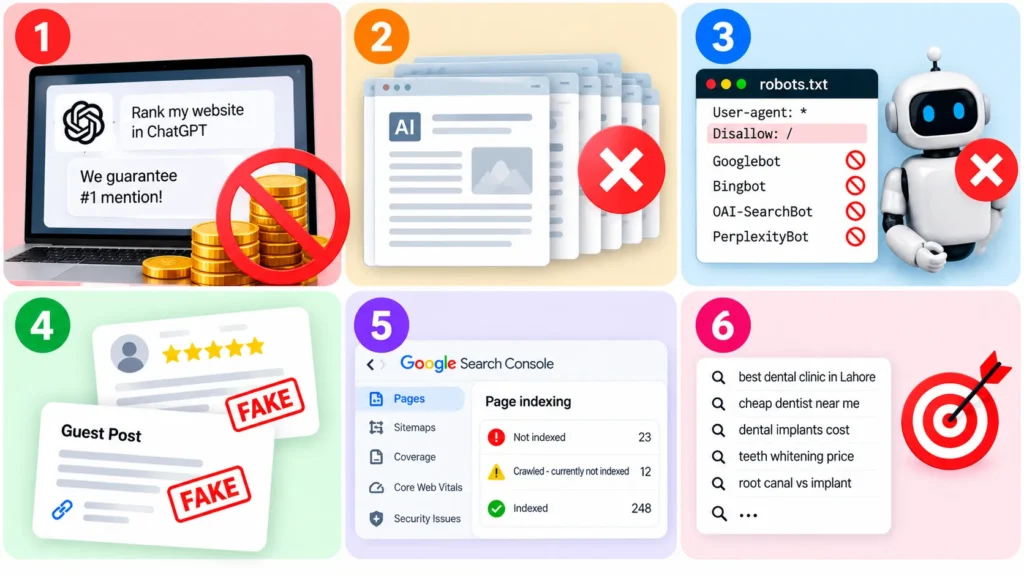
- Buying “rank in ChatGPT” packages. Nobody can guarantee a mention in an AI answer. Answers vary by user, wording and day.
- Mass producing AI written pages. Pages that repeat common knowledge are exactly what Google calls commodity content. They add cost and no visibility.
- Blocking every AI bot by default. Some site owners block all AI crawlers out of fear, then wonder why ChatGPT never mentions them. Block training bots if you want, but keep search bots open.
- Faking mentions. Paid fake reviews and spun guest posts break platform rules, and Google has said inauthentic mentions help less than people think.
- Ignoring normal SEO. Since most AI Overview citations come from top 10 pages, a site with crawl errors or thin pages will not be cited. Fixing technical SEO issues often does more for AI visibility than any AI-specific tactic.
- Chasing every prompt. Focus on the 20 to 30 questions that come right before a purchase.
When to do this yourself, and when to get help
A single location business with a clear offer can run this plan alone. The hard parts are honest content and steady outreach, and both are cheaper when the owner does them.
Getting help makes sense when:
- Your site has indexing or crawling problems you cannot diagnose
- You compete in a crowded category where competitors already appear in every AI answer
- You need to report AI visibility to partners or investors each month
If you are in that position, my AI search optimisation service covers the audit, fixes and monthly citation tracking.
Frequently asked questions
What is the difference between SEO, AEO and GEO?
SEO is optimizing to rank in search engines. AEO (answer engine optimization) and GEO (generative engine optimization) are newer names for optimizing to appear in AI written answers. Google says optimizing for its generative AI features is still SEO, so in practice they share the same foundations: crawlable pages, useful content and a trusted brand.
How do I get my business mentioned by ChatGPT?
Allow OAI-SearchBot in robots.txt, make sure your pages are indexed by Google and Bing, publish specific information such as prices and results, and get your brand named on the websites ChatGPT already cites for your topic. Check progress by asking your target questions in a private window once a month.
Do I need llms.txt to appear in Google AI Overviews?
No. Google’s May 2026 guide says llms.txt and other AI-specific files are not needed for generative AI features in Google Search. A page only needs to be indexed and eligible to show with a snippet.
Does blocking GPTBot remove my site from ChatGPT search?
No. OpenAI uses GPTBot for model training and OAI-SearchBot for ChatGPT search results. You can block GPTBot and still appear in ChatGPT search, as long as OAI-SearchBot is allowed.
Can I see AI Overview clicks in Google Search Console?
Not separately. Google includes AI Overview and AI Mode data in the Web search type of the Performance report but does not split it out. Rising impressions with flat clicks on a page often point to AI Overview exposure.
How long does it take to appear in AI answers?
ChatGPT and Perplexity can start citing a well structured page within weeks once it is indexed, because they search beyond page one. Google AI Overviews mostly cite pages already in the top 10, so they follow your normal ranking progress, which often takes several months.