


An SEO package in Pakistan is a fixed monthly (or one-time) bundle of SEO work sold at a set price. A good package names the pages that will be worked on, the technical fixes, the content to be written, the Google Business Profile work, how links will be earned and how results will be reported from your own Google accounts. Packages sold mainly on keyword counts or backlink numbers usually deliver the least.
Who this guide is for
This guide is for business owners in Pakistan who have one or more SEO package sheets in front of them and want to know what they are actually buying. It explains every common line item, shows what published packages look like right now, and lists the package traps that cost money without moving rankings.
If you want to know what SEO costs across the market, read my breakdown of SEO cost in Pakistan. This page is about what sits inside the package, not the price tag.
What is an SEO package?
An SEO package is a pre-defined scope of search engine optimisation work, priced per month or per project. The provider decides the deliverables in advance, groups them into tiers (often called Basic, Standard and Premium) and sells the same structure to many clients.
Packages exist because they make SEO easier to sell and easier to buy. You see a price, a list and a start date. The problem is that SEO work depends on the condition of your website, your market and your competitors. A package written before anyone has looked at your site is a guess about what you need.
That does not make every package bad. It means the package sheet is where you start asking questions, not where you stop.
What SEO packages in Pakistan usually include
Most package sheets mix six groups of work. The names change from provider to provider, but the work underneath is the same. The table shows each common line item, what it should mean in practice and what to check before you agree to it.

| Line item on the sheet | What it should mean | What to check |
|---|---|---|
| Keyword research | A list of search terms mapped to specific pages on your site | Ask to see which page each keyword is assigned to |
| SEO audit | A crawl and review of technical, on-page and link issues | Ask if you receive the findings in writing |
| On-page optimisation (X pages) | Titles, headings, copy, internal links and images improved on named pages | Ask which pages, and what changes are made on each |
| Technical SEO / speed optimisation | Fixing crawl, indexing, Core Web Vitals and mobile problems | Ask if fixes are done or only reported |
| Content (X words or X blogs) | New or rewritten pages written around real searches | Ask who writes it and who chooses the topics |
| GMB / Google Business Profile | Categories, services, photos, posts and review handling on your profile | Ask how often it is updated and by whom |
| Local citations | Your business name, address and phone listed on directories | Ask for the list of sites and the logins |
| Backlinks / link building | Links from other websites pointing to yours | Ask where the links come from and how they are earned |
| Schema markup | Structured data that helps Google read your business details | Ask which schema types will be added |
| Monthly report | A summary of work done and results | Ask whether data comes from your own Search Console and Analytics |
Research and audit
This is the work done before anything changes on your site. It includes keyword research, a technical crawl with a tool such as Screaming Frog, a look at your top competitors and a review of your Google Search Console data.
- A proper audit ends with a priority list, not a 90-page export from a tool.
- Keyword research is only useful when each keyword is mapped to one page.
- If a package skips research and goes straight to “monthly link building”, the provider is working blind.
Technical work
Technical SEO covers anything that stops Google from crawling, indexing or ranking your pages. Typical tasks are fixing broken pages and redirects, cleaning up the XML sitemap and robots.txt file, removing duplicate pages and improving Core Web Vitals (Largest Contentful Paint, Interaction to Next Paint and Cumulative Layout Shift).
Watch the wording. “Speed optimisation” listed as quarterly or monthly often means someone runs PageSpeed Insights and sends you the score. Fixing speed on a WordPress or Shopify site usually needs changes to themes, images, plugins or hosting, and someone has to do that work.
On-page and content work
On-page work improves pages you already have. Content work adds new pages or rewrites weak ones. Both should be tied to specific searches your customers make.
- “5 pages optimised” should come with the list of five pages.
- “3,000 words per month” tells you volume, not value. One service page that answers a buyer’s questions can do more than four thin blog posts.
- Ask whether the provider will also fix pages that get traffic but no enquiries. That is content optimisation, and it often brings faster results than new posts.
Local SEO work
For clinics, shops, restaurants, rent-a-car businesses and service companies, most new customers come from the Google Maps results. That makes local SEO the most important part of the package, yet many sheets reduce it to a single line: “GMB optimisation”.
Real local work includes:
- Choosing the right primary and secondary categories on your Google Business Profile
- Adding services, photos, opening hours and regular posts
- A system for asking customers for reviews and replying to them
- Making your name, address and phone number (NAP) consistent on directories
- Location or area pages on your website for each branch or service area
Off-page and link work
Off-page SEO is the work done outside your website, mainly earning links and mentions from relevant sites. In package sheets it is usually written as a number: “20 backlinks per month” or “10 guest posts”.
Google’s spam policies treat buying links that pass ranking value as a link scheme. A package that guarantees a fixed number of links every month is, in most cases, buying them or placing them on low-quality sites built to sell links. That risk sits with your domain, not the provider’s.
Reporting and access
Reporting is where you find out whether the package is working. Two free Google tools, Search Console and Google Analytics 4, show clicks, impressions, rankings and conversions. A provider can use paid tools such as Ahrefs, Semrush or Local Falcon on top, but the base numbers should come from accounts you own.
Types of SEO packages
Not every business needs a monthly retainer. These are the package types you will see in Pakistan and who each one suits.
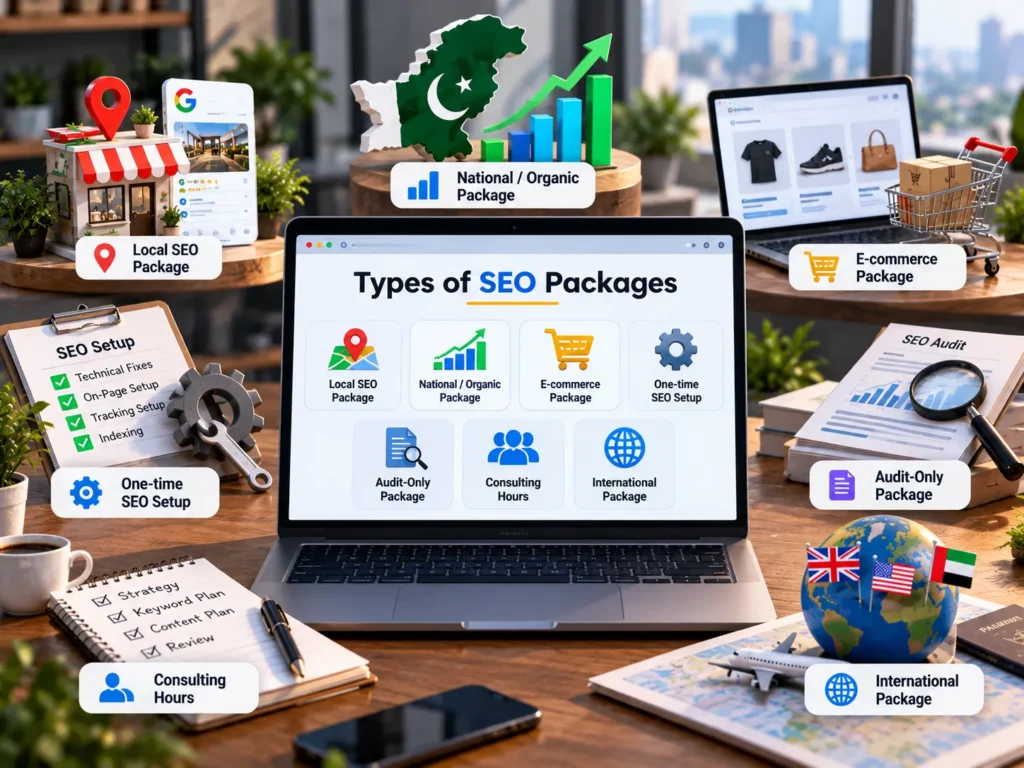
| Package type | Best suited to | Typical scope | How it is billed |
|---|---|---|---|
| Local SEO package | Single or multi-branch businesses selling in one city | Google Business Profile, reviews, citations, location pages | Monthly |
| National / organic package | Businesses selling across Pakistan or online | Technical fixes, content, on-page work, links | Monthly |
| E-commerce package | Online stores on Shopify, WooCommerce or custom builds | Category and product pages, filters, indexing, technical clean-up | Monthly or project |
| One-time SEO setup | New websites or sites that have never had SEO | Audit, technical fixes, on-page set-up, tracking | One payment |
| Audit-only package | Owners with an in-house team or developer | Written audit and priority list | One payment |
| Consulting hours | Businesses with a marketing team that needs direction | Strategy calls and review of team’s work | Hourly or monthly |
| International package | Pakistani businesses targeting the UK, US or Gulf | Market-specific keywords, hreflang, content per country | Monthly |
If your business is an online store, e-commerce SEO packages should be built around categories and products, not around a fixed keyword count. A store with 2,000 products has a very different job from a five-page service website.
What published SEO packages in Pakistan look like right now
I reviewed the SEO package pages that rank on Google for “SEO packages Pakistan” in October 2026. The pattern across them is consistent:
- Three to six tiers, usually named Starter, Standard, Business, Premium or Enterprise.
- PKR pricing from about 30,000 to 180,000 per month on the agency pages that publish rupee prices.
- USD pricing from about $199 to $599 per month on pages aimed at foreign clients.
- Tiers separated mainly by keyword count, for example 10, 25 to 30, 40 to 60 and 75 to 100 keywords.
- Content measured in words or number of blogs, for example 2 to 10 blog posts or 3,000 to 12,000 words a month.
- Google Business Profile work usually missing from the cheapest tier and added only at mid or top tiers.
- At least one page promising a ranking guarantee expressed as a percentage of keywords.
| What changes between tiers | What it tells you |
|---|---|
| More keywords | More terms tracked, not always more pages improved |
| More words or blogs | More content volume, quality not stated |
| More “pages optimised” | Closer to real work, ask which pages |
| GMB added at higher tiers | Local work treated as an extra, not the core |
| “Dedicated manager” at higher tiers | More communication, not always more SEO hours |
The main thing this snapshot shows: most package tiers are priced by quantity of outputs, while rankings depend on the quality of a few specific changes. Read the sheet with that in mind.
The line items that matter most
When two packages look similar, these are the details that separate useful work from busy work.
- Named pages. A package that lists the actual URLs to be improved is far more accountable than one that says “on-page SEO”.
- Who does the work. Ask whether fixes are made directly on your site or only recommended for your developer to do.
- How links are earned. Outreach, local partnerships, supplier pages and press mentions are fine. A monthly quota is a warning.
- Google Business Profile depth. For local businesses this should be the largest part of the package, not one bullet.
- Your data, your accounts. Search Console, Analytics and your Business Profile should stay in your name with full access.
- A change log. A written list of every edit made each month. Without it, you cannot tell work from waiting.
Package traps to avoid
These traps are specific to how packages are written and sold. For the wider list of mistakes people make when choosing a provider, see mistakes when hiring an SEO expert.
Keyword count used as the headline
“50 keywords” sounds like more than “10 keywords”, but tracking a keyword is not the same as ranking for it. Ten keywords mapped to ten well-built pages will usually outperform fifty keywords spread thinly across a homepage.
Backlinks sold by quantity
Fixed monthly link numbers, “DA 50+ guest posts” and “high PR links” are usually bought placements on sites that exist to sell links. They can work for a while and then trigger a manual action or quietly stop counting after an update.
Content measured in words, not usefulness
A word count says nothing about whether the content matches what people search for. Ask for the topic list and the target page for each piece before the month starts.
“GMB optimisation” as one line
Without detail, this can mean a one-time edit of your business description. Ask how often posts, photos and services will be updated, and who handles reviews.
Reports only from the provider’s dashboard
Rank trackers and branded dashboards are useful, but they can be filtered to show only good news. Make sure the report also includes figures from your own Google Search Console and Analytics.
Setup fees and tools billed on top
Some packages add a separate setup fee, or charge for tool licences such as Ahrefs or Semrush on top of the monthly price. Neither is wrong in itself, but both should appear on the package sheet, not on the first invoice. Provincial sales tax on services may also apply depending on where you and the provider are registered, so ask for the all-in monthly figure.
Lock-in periods hidden in small print
A six or twelve-month minimum term is sometimes mentioned only in the contract. Check the term and the exit clause before paying. My guide to the SEO contract explains which clauses protect you.
Ranking guarantees
Google itself states that no one can guarantee a number one ranking. A package promising a percentage of keywords on page one is selling confidence, not a service.
How to compare two SEO packages side by side
Package sheets are written to look different even when the work is the same. Put them on one grid and compare the work, not the wording.
- List every deliverable from each sheet in one column.
- Rewrite each one as a concrete monthly action (“rewrite 4 named service pages”, “publish 2 location pages”, “10 Business Profile posts”).
- Mark anything that has no clear output as “unclear” and ask the provider to define it.
- Add the all-in monthly price, the minimum term and the exit notice.
- Compare cost against defined work only.
| Compare this | Package A | Package B |
|---|---|---|
| Pages improved each month (named) | ||
| New pages or content pieces (topics listed) | ||
| Technical fixes done, not just reported | ||
| Google Business Profile tasks per month | ||
| How links are earned | ||
| Reports from your own Google accounts | ||
| Setup fee / tool fees / tax | ||
| Minimum term and exit notice | ||
| All-in monthly price (PKR) |
This grid compares the packages. To judge the person or agency behind them, use these questions to ask an SEO expert before hiring, and decide first between an SEO expert vs SEO agency.
Which package fits your business?
| Your situation | Package that usually fits | Main focus |
|---|---|---|
| Single clinic, shop or office in one city | Local SEO package | Business Profile, reviews, citations, service pages |
| Business with several branches | Multi-location local package | One profile and one page per branch |
| Online store | E-commerce package | Categories, products, indexing, site speed |
| New website, no SEO done yet | One-time setup, then a small monthly plan | Technical set-up, tracking, core pages |
| Traffic dropped suddenly | Audit or recovery project first | Find the cause before any monthly work |
| SaaS or business selling abroad | National or international package | Content, technical depth, AI search visibility |
| In-house marketer already on staff | Audit-only or consulting hours | Direction and review, not delivery |
For businesses that want to appear in Google’s AI Overviews and in ChatGPT or Perplexity answers, check whether the package includes AI search optimisation such as structured data, consistent business facts and answer-style content. Most standard packages in Pakistan do not include it yet.
When you do not need a monthly package
A monthly package is the wrong buy in a few common situations:
- You need leads this month. SEO usually takes months. Google Ads or Meta ads are the faster channel while SEO builds.
- Your website is about to be rebuilt. Paying for on-page work on a site that will be replaced wastes the budget. Do SEO planning with the rebuild instead.
- The problem is one specific fault. An indexing error, a broken redirect setup or a suspended Business Profile is a project, not a retainer.
- You have someone who can do the work. An audit with a clear priority list may be all you need.
Questions to ask about any SEO package before you pay
These questions are about the package sheet itself:
- Which pages on my site will you work on in the first month?
- Are technical fixes made by you, or only reported to my developer?
- Who writes the content, and who approves the topics?
- What exactly happens under “GMB optimisation” each month?
- Where will backlinks come from, and are any of them paid placements?
- Will I own all accounts, listings and logins created during the work?
- Is the price final, including setup, tools and tax?
- What is the minimum term and how much notice do I give to stop?
If any answer is vague, ask for it in writing. The answers become the real package; the sheet is only the summary.
Frequently asked questions
What does a basic SEO package include?
A basic SEO package usually includes keyword research for a small set of terms, optimisation of a few pages, basic technical checks, a sitemap and a monthly report. Local businesses should check whether Google Business Profile work is included, because many basic tiers in Pakistan leave it out.
Are cheap SEO packages worth it?
Cheap packages can be worth it when the scope is small and honest, such as a one-time set-up for a new site. They are rarely worth it when they promise many keywords and monthly backlinks at a very low price, because that combination usually means automated work or bought links.
How many keywords should an SEO package include?
There is no correct number. What matters is that each keyword is mapped to a page that can rank for it. A local business may do well with 10 to 20 well-chosen terms, while an online store needs coverage across categories and products rather than a fixed keyword count.
Should an SEO package include backlinks?
It should include a plan for earning links, not a fixed number of purchased ones. Relevant local links, supplier and partner pages, directory citations and press mentions are safe. Monthly link quotas often rely on paid placements, which go against Google’s spam policies.
Is local SEO included in standard SEO packages?
Not always. Many standard packages focus on website pages and treat Google Business Profile work as an add-on. If most of your customers find you on Google Maps, choose a package where local work is the main focus.
How long should I stay on an SEO package before judging it?
Most businesses should judge an SEO package after about three months, using impressions, clicks and enquiries in their own Google Search Console and Analytics. Local Business Profile changes can show earlier, while competitive national keywords take longer.
Can I switch SEO packages or providers mid-way?
Yes, if your contract allows it. Before switching, make sure you have admin access to your website, Search Console, Analytics and Business Profile, and a record of the work done. This keeps your progress safe when a new provider takes over.
Before you choose a package
The most reliable way to know which package you need is to start with a diagnosis of your own site. My free SEO audit shows what is holding your site back and which type of package, if any, makes sense. If you would like to see how I structure monthly plans in rupees, you can compare them on my SEO pricing and packages page.